
Dollar Rate in Pakistan: Buying, Selling and Sources
Understand dollar rates in Pakistan, distinguish interbank and customer quotations, and calculate conversion costs using a dated source and clear fees.
A dollar rate in Pakistan is useful only when you know the currency, the direction of exchange, the quotation type and the time it applies. Most readers mean the US dollar against the Pakistani rupee, written USD and PKR. A bare number cannot tell you what a customer will pay or receive.
The practical question is the final amount for your particular transaction. A bank transfer, foreign-currency cash exchange and remittance can involve different rates, fees and settlement arrangements. Comparing headline quotations without those details can make a costly offer appear cheaper.
An exchange rate describes a price relationship, while exchange-rate risk concerns uncertainty about how that relationship may change. This article explains how to read a quotation and check the arithmetic. All numerical rates and fees below are invented teaching examples, not current market quotes. Use the method with a dated offer from an authorised provider, and request the final payable or receivable amount before confirming a transaction.
Which buying or selling rate applies to your transaction?
Buying and selling are normally described from the provider's perspective. If you hand dollars to a provider and receive rupees, the provider is buying dollars. If you hand over rupees to obtain dollars, the provider is selling dollars. Confirm that convention on the particular quotation rather than guessing from the column order.
Imagine a display with a buying rate of PKR 280 and a selling rate of PKR 282 for one USD. Selling USD 100 to that provider produces PKR 28,000 before any separately disclosed charges. Buying USD 100 requires PKR 28,200 before those charges.
The PKR 2 difference is the spread between the quoted sides. It is not automatically an extra fee added after the calculation; the rate you use already reflects the relevant side. A commission, if separately charged, is a different item and should be disclosed clearly.
An immediate round trip illustrates the distinction. Buying USD 100 at 282 and selling it back at 280 would lose PKR 200 before other costs if those quotations remained unchanged. This arithmetic explains why a displayed midpoint is not usually a rate available to the customer in both directions.
Write your intended action at the top of the comparison: “I am selling USD” or “I am buying USD.” Then label what you give and what you receive. This simple step prevents the most common inversion and makes the provider's written explanation easier to check.
For a cash transaction, confirm the currency notes and applicable conditions. A quotation for a transfer need not apply to physical notes, and a familiar currency symbol is insufficient when several currencies share the name dollar.
Why can interbank, open-market and customer rates differ?
Different rate series describe different markets, transaction types or reporting methods. An interbank observation concerns dealings between banks, while a customer rate concerns an offer or estimate for customer business. An open market cash quotation is another category. Compare like with like before deciding that two numbers contradict each other.
The State Bank describes Pakistan's exchange-rate system as market based, with demand and supply influencing the rate. Its published data include distinct rate categories. Those categories should remain visible when a figure is reproduced in a newspaper, spreadsheet or educational chart.
The weighted average customer series is compiled from indicative commercial-bank rate sheets. It is information about quoted customer rates, not a guarantee that every bank or exchange company will execute every transaction at exactly that figure.
A mark-to-market revaluation rate has a different purpose: valuing authorised dealers' books. Using it as if it were a retail cash offer confuses an accounting reference with a transaction quotation. The source can be official while still being unsuitable for the comparison you want.
A midpoint or reference rate may help describe a market, but customers normally transact on a relevant buying or selling side with applicable charges. Ask whether a comparison tool displays an indicative rate or an executable offer for your amount.
Label a research table with currency pair, market category, buying or selling side, date and source. If a field is missing, the table may still describe something useful, but it is not ready for a precise customer-cost comparison. Restore the missing information before calculating a supposed saving.
How do you read the units, timestamp and value date?
First identify which currency one unit refers to, then check when the rate was quoted and when the transaction settles. “PKR per USD” and “USD per PKR” are inverse expressions. A timestamp records an observation or offer time; a value date describes when funds are treated as settled.
At an illustrative rate of PKR 280 per dollar, multiply dollars by 280 to obtain rupees. To express the same relationship as dollars per rupee, divide one by 280. The inverse rate is approximately 0.003571 USD per PKR, not another independent market quotation.
A screenshot showing 280 without units is incomplete. It may represent a different currency pair, an old quotation or a rounded reference. The date printed on a webpage also may be an article update date rather than the observation date in the underlying rate table.
Distinguish a closing figure from an intraday offer and a monthly average. These can legitimately differ. A monthly average summarises a period; it is not proof that a particular customer could transact at that rate on the last day.
Weekends and holidays complicate the word “today.” A website may display the latest available working-day observation while its surrounding page has today's date. Read the table heading instead of assuming that the page generated a new fixing.
For a bank transfer, ask about settlement and the beneficiary's expected receipt. An attractive rate does not independently establish arrival time. Keep rate validity, transfer timing and any conditions attached to the offer together in your record so that a later comparison uses the same transaction assumptions.
How do you calculate rupees received or dollars purchased?
For a rate expressed as rupees per dollar, multiply the dollar amount by the applicable rate to calculate the rupee equivalent. If the budget is in rupees and you are buying dollars, divide the available rupees by the selling rate after accounting for charges in the correct currency.
Suppose you sell USD 250 at an illustrative buying rate of 280. The gross equivalent is PKR 70,000. If a separately documented PKR 500 fee applies, the net amount received is PKR 69,500. The effective rate is therefore 69,500 divided by 250, or PKR 278 per dollar.
Now suppose a customer has PKR 56,400 and the selling rate is 282, with no extra fee in this example. Dividing 56,400 by 282 gives USD 200. Multiplying instead would produce an obviously inappropriate unit and an unrealistic result.
Check where a fee is deducted. A USD 5 charge removed before conversion is not identical to a PKR 5 charge removed afterward. State the currency of every amount, write each calculation separately and avoid silently combining units.
Rounding should come at a sensible final stage, using the provider's stated method. Rounding an intermediate inverse rate too heavily can distort a large conversion. Keep enough precision during working, then present the final result in the payable unit.
A useful reasonableness check asks whether the answer has the expected scale. At a rate of a few hundred rupees per dollar, a few hundred dollars should convert to tens of thousands of rupees, not a tiny fraction of a rupee. Unit checking catches many calculator-entry mistakes.
How do you compare two offers after fees?
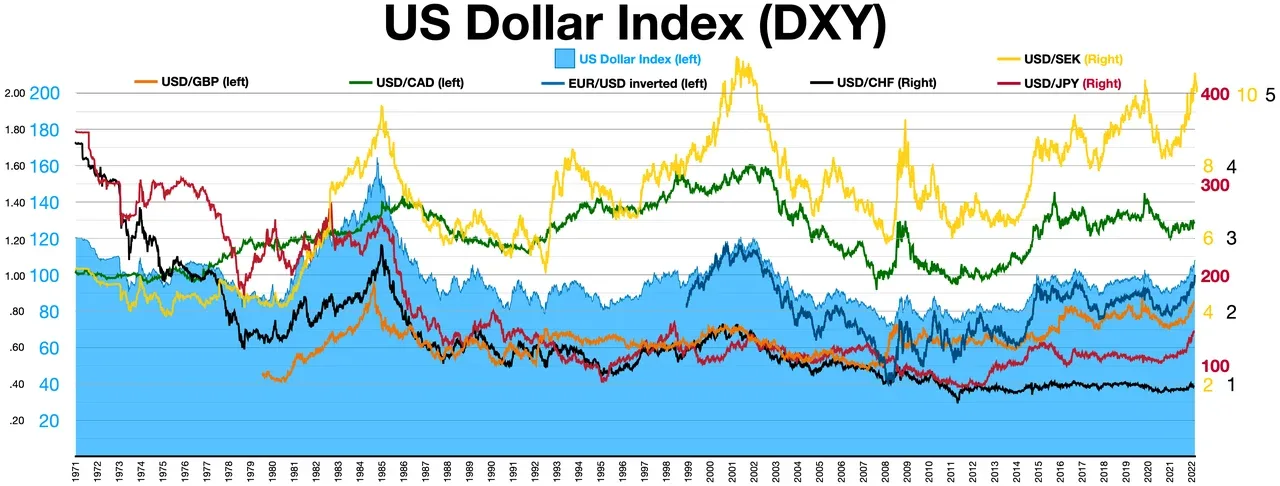
The dollar index illustrates a different market measure from a USD/PKR customer quotation; read its period and units before comparing figures.
Compare the amount the sender pays with the amount the recipient receives under identical assumptions. Rate and fee need to be assessed together. A higher buying rate can be offset by a larger transfer fee, while a fee-free claim can coexist with a less favourable conversion rate.
Consider two invented offers for a USD 500 conversion:
| Item | Offer A | Offer B |
|---|---|---|
| Quoted buying rate | PKR 280 | PKR 279 |
| Gross rupees | 140,000 | 139,500 |
| Stated rupee fee | 1,000 | 0 |
| Net rupees | 139,000 | 139,500 |
Offer B produces PKR 500 more in this specific example. The table does not rank real providers. It demonstrates why looking only at the highest rate would produce the wrong conclusion.
Fee structure also changes the comparison by transaction size. A fixed fee has a larger proportional effect on a small transfer than a large one. A percentage commission scales differently. Recalculate for your actual amount instead of transferring a conclusion from somebody else's transaction.
Ask whether intermediary deductions or receiving-bank charges are included in the estimate. If they are unknown, record the uncertainty rather than treating the displayed recipient amount as guaranteed. Compare delivery method and timing as well as arithmetic.
For an invoice or import payment, keep the invoiced currency and required recipient amount clear. A transfer that arrives short may fail to meet the intended obligation even if the headline rate looked favourable. Written terms help distinguish a pricing dispute from a calculation misunderstanding.
Does a higher dollar number mean the rupee is stronger?
When the quotation is PKR per USD, a higher number means more rupees are needed to obtain one dollar. That indicates rupee depreciation against the dollar over the stated comparison period. A lower number indicates rupee appreciation on that same quotation basis. The wording reverses if you use the inverse expression.
Suppose an illustrative rate moves from 280 to 294 PKR per USD. The dollar's rupee price rises by 14 divided by 280, or 5 percent. The rupee's dollar value moves from one divided by 280 to one divided by 294, a different percentage calculation.
That asymmetry is mathematical, not a contradiction. Percentage change uses the starting value as its denominator. Moving up by 5 percent and down by 5 percent does not return any quantity exactly to its original level.
A currency move also does not directly equal the change in every retail price. Contracts, transport costs, taxes, margins and timing can affect how a change reaches a household budget. A fuel price notification, for example, is a particular administered-price document rather than a direct display of a currency pair.
Use economic indicators to explain context, but distinguish explanation from a forecast. Demand for foreign currency, external payments and market liquidity may matter without providing a guaranteed next movement. A statement that one factor can influence rates is not proof that it caused a particular daily change.
When writing a comparison, report both dates, the same rate category and the calculation used. This lets readers verify the interpretation instead of relying on the ambiguous phrase “the dollar went up.”
What records should accompany a transfer or exchange?
Retain the quotation, transaction amount, applicable rate, disclosed charges and receipt. For transfers, also keep the recipient details and reference number in a secure location. These records allow you to reconstruct the calculation and identify whether a difference came from conversion, fees, timing or an incorrect destination.
Before confirming, read back the currency codes and account details. Similar-looking numbers or an omitted currency label can create errors that no favourable rate will correct. Use the provider's authorised process for verification rather than sharing documents with an unsolicited message sender.
Keep credentials separate from transaction evidence. A support request may require a reference number, but a request for a password or one-time login code needs independent verification through the provider's established channel. Do not post complete financial screenshots in public groups.
If the final amount differs from the quote, compare the written validity period, settlement terms and fee disclosures. Describe the discrepancy with figures and dates when contacting the provider. “The rate was wrong” is less actionable than identifying the promised and received amounts.
For school calculations, use invented account details and clearly labelled hypothetical amounts. Financial literacy practice does not require exposing a real household's remittance record. This also makes it easier to share and discuss the exercise safely.
A record is useful only if it remains readable. Save the full document rather than a cropped number, and keep the date and provider identity visible. Those details may determine which terms applied.
How can you check a dollar-rate headline before acting?
Read past the headline and identify the underlying source, rate type, units and observation date. Then obtain a transaction-specific offer for the amount and delivery method you need. A historical rate, market summary or predicted target can inform a discussion without being a price available to you now.
If a headline claims a record, ask what series and time range support it. A record within one retail sample is different from a record across all historical interbank observations. Avoid repeating the broader claim when the evidence supports only the narrower one.
Check comparisons against the same category. Combining yesterday's closing interbank rate with today's customer selling rate can manufacture a movement that partly reflects a change in definition. A fair chart holds the methodology constant.
Be especially careful with a quoted future level. A forecast is an uncertain expectation, not a payable offer or a promise. Decisions about holding currency require personal circumstances and risk considerations that a general conversion example cannot establish.
For everyday use, the strongest final question is concrete: what amount will leave my hands, what amount should arrive, and under which written conditions? Answering that question turns a general dollar search into a checkable transaction comparison.
Keep the calculation beside the final quotation until the transaction is complete. If the offer expires or changes, update both rather than carrying an old effective rate into a new decision. This preserves a clear distinction between useful market information and the actual price of your exchange.
Sources
Image credits: Cover: Hamster28, source, Public domain. Resized and converted to WebP. Article image: Wikideas1, source, CC0. Resized and converted to WebP.
Found an error or an outdated detail? Report a correction with the article URL and original source.