
Rashid Khan Reaches 200 T20I Wickets: The Meaning
Understand Rashid Khan’s 200 T20I wickets milestone, how bowling records are counted, and the difference between international and franchise cricket.

Rashid Khan reached 200 T20I wickets according to the ICC's report dated 29 October 2026. The milestone belongs to Twenty20 internationals, rather than every short-format appearance across his career. That distinction is the starting point for understanding the achievement and for comparing it fairly with other bowling records.
A wicket landmark is significant, but the number alone does not explain how a bowler creates dismissals or controls an innings. This guide shows how to read the supporting figures, recognise the limits of career comparisons and watch leg-spin with more attention to the contest between bowler and batter. Numerical spells used below are worked examples, not asserted figures from the record match.
What exactly does the 200-wicket milestone count?
The milestone counts wickets credited to Rashid Khan in the T20I statistical category up to the report's stated point. It does not combine domestic, franchise and international cricket into one figure. Keep the format and cutoff date attached whenever you repeat the record or compare it with another total.
The ICC report identifies the milestone as a first in the men's T20I category. That scope matters: a record should retain the competition and category in which it was established. Avoid shortening a precise statement into a sweeping claim about all cricket, every format or every bowling achievement.
A career total can change after another completed match. A dated story may therefore remain historically correct while a current profile displays a higher number. Put those records in chronological order before calling them contradictory. Likewise, a cached page may not reflect the most recently completed fixture.
Separate reaching a landmark from moving into first place on a list. The earlier ICC record report and the later 200-wicket report concern related but different achievements. One establishes a change in the lead; the other establishes a numerical threshold reached later.
For your own record sheet, include player, category, date, wickets and source. This is the same basic discipline needed for Sahibzada Farhan's dated rankings, although a ranking position and a wicket count measure different things.
Which dismissals belong to the bowler's wicket tally?
A bowler's total includes dismissals officially credited to the bowler, while a run-out contributes to the team's wickets without becoming a bowling wicket. Read the dismissal notation in the completed scorecard. The team losing a batter and a bowler receiving statistical credit are related but distinct events.
Common credited outcomes include bowled, caught, lbw and stumped, subject to the laws and playing conditions. A fielding action can be essential to the dismissal without removing the bowler's credit. For example, a catch involves the fielder, but the scorecard records it differently from a run-out.
Do not infer dismissal type solely from a highlight's final image. Stumps being broken can occur in several circumstances. Read the actual decision, especially if the delivery includes an extra, a review or a complicated sequence. The scorer's record provides the statistical category you need.
Imagine a fictional innings with three catches from a spinner's bowling and one run-out during the same spell. The team has lost four wickets across that passage, but the spinner has three credited wickets. Treating the whole passage as four bowling wickets would overstate the individual figure.
This distinction also helps you discuss teamwork fairly. A wicket can involve a plan, accurate execution and a good catch. Recognising the bowler's statistical credit does not require ignoring the fielding contribution. Explain both without inventing an alternative official tally or assigning every dismissal entirely to one person.
How do average, economy and strike rate differ?
Bowling average measures runs conceded per wicket, economy rate measures runs conceded per over and bowling strike rate measures legal deliveries per wicket. Each describes a different relationship. Use them together, because a bowler can control scoring without frequent wickets or take wickets while conceding heavily.
Take a fictional four-over spell conceding 24 runs and taking two wickets. It contains 24 legal deliveries. The economy rate is six, the bowling average for the spell is twelve and the strike rate is twelve balls per wicket. The identical final two values are a coincidence of this example.
Now compare a fictional four overs for 36 with three wickets. Economy rises to nine, average remains twelve and strike rate improves to eight. The second spell takes wickets more frequently but allows faster scoring. Deciding which was more valuable requires the match situation.
Read the measures together
| Figure | Calculation | Main question |
|---|---|---|
| Average | Runs conceded divided by wickets | What did each wicket cost? |
| Economy | Runs conceded divided by overs | How fast did opponents score? |
| Strike rate | Legal balls divided by wickets | How frequently did wickets fall? |
| Total wickets | Credited dismissals | How large is the accumulated record? |
A wicketless spell has no meaningful runs-per-wicket average for that spell because the denominator is zero. Do not label it zero, which would imply an entirely different result. Report the runs and workload, then explain what pressure or control the actual sequence supports.
Why must overs be converted before calculating rates?
Overs contain six legal deliveries, so their scorecard notation is not a decimal fraction. A display of 3.2 means three overs and two balls, or twenty legal deliveries. Convert to balls before calculating economy or strike rate, then use the appropriate denominator for the figure you need.
For an illustrative 25 runs from 3.2 overs, the economy calculation is 25 multiplied by six and divided by twenty, giving 7.5. Dividing by the ordinary decimal 3.2 would give the wrong result because the notation encodes balls rather than tenths of an over.
Wides and no-balls need careful handling because they can add runs without using another legal delivery. Byes and leg-byes appear in the innings total but are not ordinarily charged to the bowler. Use the recorded bowling figures rather than reconstructing conceded runs from a cropped team-total graphic.
Workload can also be spread across several spells. A bowler might deliver early, return in the middle overs and finish near the end. The final line combines those assignments. If a review describes the whole spell as occurring against one batter or during one phase, verify that the ball-by-ball record supports it.
The T20I scorecard guide provides more practice with legal-delivery counts and chase equations. These calculations are simple once the units are clear, and consistently correct units prevent an apparently sophisticated comparison from resting on an avoidable arithmetic error.
What should you watch in a Rashid Khan spell?
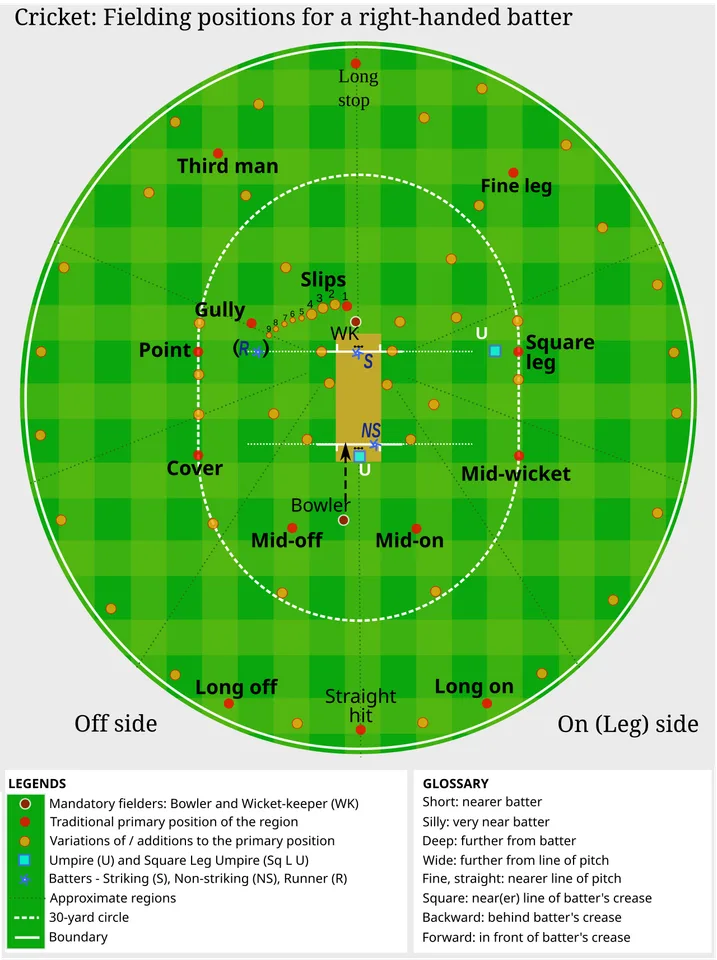
Fielding positions help connect a spinner's line with catching and boundary protection. This is a general reference, not Rashid Khan's field in the milestone match.
Watch release, line, length, pace and the batter's response before naming a variation or judging its success. Leg-spin can challenge expectations through turn and changes in trajectory or speed. A useful observation connects the delivery with the field setting and the shot attempted, rather than identifying every wicket as the same trick.
A leg break and a googly are different deliveries for a right-arm wrist-spinner, but an individual ball's movement should be identified from adequate evidence. A single camera angle can make judgement difficult. If the footage is unclear, describe the observed direction or the commentary's identification without claiming certainty you do not have.
Flight concerns the ball's path through the air; length concerns where it pitches. Both can affect when the batter commits to a shot. A slightly altered pace may disturb timing even if visible turn is limited. Big sideways movement is therefore not the only sign of a difficult delivery.
Use a sequence of six balls as a study unit. Record where each pitches, the shot chosen and the outcome. Then ask whether the final ball exploits an expectation built by earlier deliveries. This is a hypothesis to test, not proof that the bowler consciously planned every detail.
For a contrast in style and workload, study the Nayeem Hasan off-spin guide. Comparing different spin approaches helps you see why surface, role and batter movement matter more than treating all slower bowling as one interchangeable method.
How does the innings phase change a bowler's task?
Powerplay, middle overs and death overs create different scoring intentions and fielding constraints. A bowler's figures should be interpreted against that assignment. Two spells with the same economy rate can involve very different demands, particularly when one attacks an established partnership and another protects a closing target.
During a chase, wickets in hand influence how much risk a batter may accept. A side needing rapid acceleration may attack a delivery it would otherwise defend. A wicket in that situation can reflect pressure from the required rate as well as bowling quality. Describe the interaction.
Dot balls can build that pressure. Several scoreless deliveries can force the batter to seek a boundary, but do not assume every boundary attempt was caused by the previous dots. The scorecard and observed shot selection support a narrower account of the sequence, not direct access to the batter's thoughts.
Field placement is part of the contest. Protection on one side may encourage a different scoring route, while an attacking catcher can make a particular edge more dangerous. Watch changes between balls and connect them with what follows. A static scorecard does not display those spatial choices.
A useful review can divide a spell by phase and report what changed: target equation, partners, field or delivery plan. That makes the analysis more explanatory than calling a spell economical or expensive without saying what it was asked to accomplish.
Can wickets alone identify the better bowler?
Wickets describe accumulated dismissals, but a complete comparison also needs opportunity, conditions and efficiency. A longer career or a busier schedule can produce more wickets without proving superiority in every respect. State whether you are comparing longevity, wicket-taking frequency, scoring control or performance in a defined role.
Choose the same statistical category and cutoff date for every player. Mixing one player's T20I wickets with another's all-T20 total produces an invalid comparison even if both numbers are copied correctly. Keep franchise records in a separately labelled table when they are relevant.
Set a minimum sample before looking at the result. A bowler with a handful of outstanding games can have an extraordinary average that may not be comparable with years of work. The chosen threshold is an analytical decision, so state it and avoid presenting it as an official universal standard.
Opponent strength and venue mix can add context, but only if defined consistently. Do not assign vague labels such as easy wickets to an entire career without examining the actual record. Even a useful split cannot capture every pitch, dropped chance or tactical responsibility.
For Afghanistan and other international teams, fixture opportunities differ, so sample size belongs beside every rate-based comparison.
A balanced assessment might recognise that a player leads in total wickets while another has a better rate in a narrower sample. Those statements can coexist. The goal is to answer a clear question, not to choose whichever statistic confirms a favourite player and ignore the rest.
How can students turn the landmark into a useful analysis?
Build a small, reproducible study around the milestone rather than compiling an unsourced career tribute. Start with the dated record, select a few completed scorecards and calculate the same measures for each. Then use a short passage of footage to explain one pattern the numbers alone cannot show.
A practical worksheet has columns for match, overs, conceded runs, wickets, economy and phase. Add a separate observation column for visible details such as field changes. Keep this column descriptive so a personal interpretation does not accidentally become an official statistic.
For a second exercise, invent two contrasting spells and ask which suits a team defending a modest total. One might offer fewer wickets but tighter control; the other might dismiss batters while conceding more. Explain the trade-off and identify what additional context would change the answer.
When writing the final paragraph, distinguish the established 200 T20I wickets milestone from your own analytical conclusion. You can explain why sustained international wicket-taking is noteworthy without claiming that one total settles every debate about bowling value or predicts the next match.
Retain your calculations so another student can check them. If a number is corrected, update the conclusion that depends on it. This makes the landmark a route into statistical literacy: clear categories, accurate units, fair comparisons and a willingness to revise an interpretation when the evidence changes.
Before publishing a fresh career total, recheck the most recent completed international record. For historical discussion, retain the original milestone date rather than rewriting the past to match today's tally. That final distinction preserves both the achievement and the accuracy of later comparisons.
An additional comparison can examine wicket timing. Use fictional identical figures in two different situations: one spell breaks a settled top-order partnership, while another removes late batters after the target has become very difficult. Both earn the same recorded wickets. Discuss why a match report might describe their impact differently, and which observations support that description. This keeps statistical credit intact while making room for the context that gives a sporting performance meaning.
Sources
Source 1 · Source 2 · Source 3 · Source 4
Image credits: Cover: Afghanistan Cricket Board, source, CC BY 3.0. Resized and converted to WebP. Article image: See source attribution, source, CC BY-SA 4.0. Resized and converted to WebP.
Found an error or an outdated detail? Report a correction with the article URL and original source.