
Nayeem Hasan: A Guide to Reading Spin Bowling
Study Nayeem Hasan through the essentials of spin bowling, match context and scorecards, without confusing one spell with a full career record.

Nayeem Hasan is a Bangladesh right-arm off-spin bowler whose performances are best understood through the match, innings and spell being examined. Official player records establish the identity and bowling style. To evaluate a particular contribution, go beyond a wicket total and examine how the deliveries, field and batting response developed over time.
This guide concentrates on long-spell reading and the changing contest in Test cricket. It uses a dated historical example for context and fictional figures for calculations. The aim is to help a student explain what an off-spinner accomplished without assuming that every turning ball was unplayable, every wicketless over was harmless or every successful spell came from the pitch alone.
Which player and performance should you identify first?
Confirm the player's full name, team, format, opponent, venue and date before copying a statistic. An abbreviated scoreboard or old highlight can create confusion, particularly when a familiar first name appears in different teams. Then identify whether the figure describes one innings, a whole match or a career.
Nayeem's official records include Test cricket, but that does not mean every number beside his name belongs to the same statistical category. Read the column labels and filters. A youth record, a domestic performance and a senior international figure should not be silently combined.
For a clear historical anchor, the ICC's report dated 25 February 2020 describes his nine wickets in the match against Zimbabwe. That is a specific documented performance, not a claim that it represents a newly achieved total or his current record. Keep the historical date visible.
A match figure can combine two innings, while a best-innings figure concerns one. Confusing them can make a bowler appear to have taken more wickets in a single innings than the record actually says. Write the scope out in words before using the shorthand.
Selection also needs its own evidence. A squad announcement does not establish participation in the final team, and an old profile item does not establish a new injury. For broader fixture-checking habits, the England and Sri Lanka guide shows why match identity comes before analysis.
What should you watch before and after the ball pitches?
Separate movement through the air from movement after pitching. Flight, drift and dip concern the aerial path, while turn and bounce concern what happens after contact with the surface. Watch the full delivery and the batter's adjustment before deciding which feature created difficulty.
Line describes the ball's direction relative to the stumps and batter; length concerns where it lands. A small change can alter whether the batter comes forward, goes back or attempts an attacking shot. Do not judge length only by a fixed distance without considering the player's reach and movement.
Pace and release point add further variables. A delivery arriving faster can change the time available for a response, while a different angle can change the apparent line. These are aspects to observe, not automatic proof that the bowler deliberately used a named variation on every ball.
For a video study, watch six consecutive deliveries at ordinary speed before using slow motion. Record the landing area, movement and shot. Slow motion can reveal details, but it can also exaggerate the apparent time available to the batter. Keep the real-time problem in view.
If the camera angle is insufficient, use cautious description. Say the ball appeared to turn or the batter adjusted late, rather than assigning an exact amount of drift from a distant view. Good analysis identifies what the evidence can show and where measurement would be needed for a stronger claim.
How do angle and batter handedness affect the contest?
An off-spinner's angle changes with over the wicket or round the wicket positioning, and the batter's handedness changes the relationship between line and expected turn. Read those elements together. A delivery described as moving toward one batter may create a different problem for a player using the opposite stance.
Start by identifying the right-handed or left-handed batter. Then draw the stumps, approximate release position and pitching area on a simple diagram. Label it as a schematic rather than a measured trajectory. This helps prevent verbal descriptions of direction from becoming confused.
Footwork changes the geometry again. A batter moving forward can reach the pitching area sooner, while going back may provide more time after the bounce. Advancing down the pitch can also create risk if the ball beats the bat and the wicketkeeper is positioned to respond.
Watch which route the batter chooses repeatedly. Does a defensive shot keep the ball close? Does a sweep attempt target a protected area or an open gap? A successful boundary can be a reasonable response without proving that the bowler's plan was poor across the whole spell.
For comparison, the Rashid Khan leg-spin guide examines a different spin approach and a short-format record. Keeping style and format distinct helps you discuss common principles without pretending that every spinner presents the same direction, pace or tactical problem.
How does the field explain a spin-bowling plan?
A field setting shows which outcomes a team is preparing to contest. A slip, short leg or silly point can create catching opportunities near the bat, while deeper fielders protect scoring areas. The arrangement offers clues about a plan, but it does not disclose every instruction or guarantee a particular dismissal.
Observe the close catcher positions before the delivery. An edge or bat-pad chance may be more dangerous when someone is placed to receive it. Yet the presence of a catcher alone does not prove that every ball is intended for that exact outcome. Connect the field with repeated line and length.
Questions for a field sketch
| Area to note | What it may help explain | What remains uncertain |
|---|---|---|
| Catchers near the bat | Potential dismissal routes | Exact tactical instruction |
| Boundary protection | Areas the side wants to cover | Whether a shot was deliberately invited |
| Single-saving positions | Pressure on rotation | Whether the batter accepts the risk |
| Changes between overs | Response to a new situation | Coach or captain's private reasoning |
A single moved fielder can matter. If a gap closes, the batter may need another scoring option. Record the change and the next few deliveries instead of assuming the next wicket proves the move caused it.
Also watch the bowler at the other end. Pressure can be shared: one end restricts scoring while the other attacks, or both use different angles to the same partnership. An individual spell belongs to that wider sequence, so a fair explanation should not isolate it completely from the team's work.
What do overs, maidens, runs and wickets reveal?
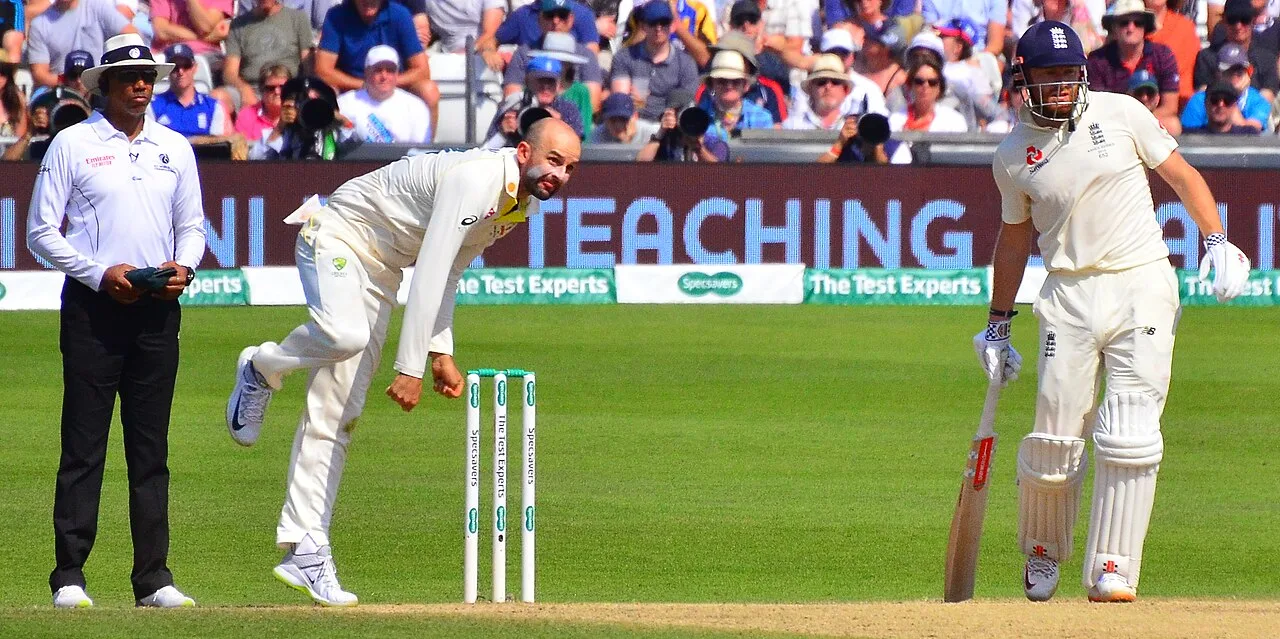
Nathan Lyon, not Nayeem Hasan, provides a contextual off-spin example for observing angle, batter position and the umpire's view.
These columns summarise workload, scoring and dismissals, but their meaning depends on the innings and role. Maidens identify overs without runs charged to the bowler, while runs conceded and wickets support rate calculations. Read the scorecard definitions carefully and avoid treating the final line as a complete account of pressure.
Imagine a fictional ten-over spell with three maidens, 24 runs conceded and two wickets. It contains sixty legal balls. The economy rate is 2.4, the bowling average for the spell is twelve and the strike rate is thirty deliveries per wicket. These are teaching figures, not Nayeem's reported statistics.
Now imagine the same runs and wickets spread across two shorter spells with a long break. The aggregate line is unchanged, but the rhythm and match assignments may differ. Mark the start and end of each spell if you want to explain sustained pressure or a successful return later in the innings.
Overs notation also needs care. A display of 14.3 means fourteen overs and three balls, not 14.3 ordinary decimal overs. Convert to balls before calculating rates. This keeps an otherwise thoughtful comparison from being distorted by a unit error.
For supporting arithmetic, the full ODI scorecard guide explains how innings figures fit together. The format differs, but the principle remains: reconcile the team total, extras and individual bowling figures before interpreting what the numbers suggest.
Why can a long Test spell differ from four T20 overs?
A long Test spell can work through repeated challenges, changing conditions and a batter's response over many overs. A T20 assignment operates within a much shorter scoring contest. Compare each against its own purpose rather than assuming that the same wicket or economy expectation applies universally.
In a Test, a session can include a defensive rebuilding period without a fixed limited-overs target forcing immediate acceleration. The bowler may seek an edge, disturb a settled partnership or help create pressure at the other end. Those possibilities need evidence from the actual sequence.
The new ball and old ball can also present different conditions. Surface wear, rough areas and changing bounce may matter, but do not make them explanations by default. Compare deliveries, locations and batter responses before claiming that deterioration caused every dismissal.
A wicket late in a spell may follow accumulated pressure, a change of delivery or a poor shot unrelated to the preceding plan. A fair account can examine all three possibilities. Resist the temptation to describe every later success as inevitable because the earlier overs were tidy.
Workload deserves description without unsupported medical inference. A bowler delivering many overs has a documented physical assignment; that does not establish an injury or tell you exactly how tired the player felt. Record what changed visibly, such as accuracy or pace, and leave private physical states to reliable reporting.
How can you judge a wicketless spell fairly?
A wicketless spell can still restrict scoring, challenge technique or support pressure from the opposite end. Evaluate those contributions with observable evidence. At the same time, do not invent hidden dominance simply because the bowler is admired. Control, threat and wickets are related measures that can point in different directions.
Record how often batters score comfortably and where they find singles. If the partnership rotates strike easily, a low boundary count may not establish pressure. Conversely, several defensive responses and blocked scoring routes can explain why the batting side struggles to advance despite keeping its wickets.
Watch chances and near misses carefully. A dropped catch is a specific event if the footage or record establishes it. A ball passing the edge is not a wicket that should have been awarded. Describe the opportunity without rewriting the official outcome to make the figures more flattering.
A useful fictional comparison pairs two wicketless spells: one has several loose deliveries but no boundaries because of good fielding; another repeatedly beats the bat but includes one costly over. Explain the distinction and acknowledge what the final figures do and do not capture.
Avoid a single overall label when the evidence is mixed. You can say a bowler maintained an economical line while creating few visible chances, or attacked effectively while allowing scoring opportunities. That level of precision makes the review more informative than declaring the entire spell either excellent or useless.
What does a good Nayeem Hasan analysis look like?
A good analysis identifies the performance, explains the spell's assignment, uses accurate figures and supports one or two tactical observations with a visible sequence. It distinguishes innings and match totals and keeps historical examples dated. The result should explain a contribution rather than merely repeat a wicket count.
Begin with the state when the bowler entered: score, established batters, ball age and the immediate match question. Then describe the field and delivery pattern you can actually observe. Finish with what changed by the end of the spell and what remained unresolved.
Check dismissal descriptions individually. Bowled, caught, lbw and stumped point to different sequences, while a run-out is not credited as a bowling wicket. A review can recognise team fielding work without altering the scorer's allocation of individual credit.
For a student worksheet, choose one completed innings and divide observations into facts, calculations and interpretations. A fact might be the recorded wicket. A calculation might be economy. An interpretation might concern a plan to deny an easy single. Keeping those categories distinct makes correction easier.
Set a clear sample size for wider claims. One effective spell on a turning surface is evidence of that performance, not proof of identical effectiveness in every country or format. Several comparable spells can support a broader argument, provided you explain how they were selected.
Finally, write a paragraph that another viewer could challenge constructively. Give the over or sequence, describe what happened and explain why it matters. The ability to revisit evidence is the value of performance analysis: it turns a familiar player search into a precise lesson in cricket, observation and fair statistical reasoning.
As a final exercise, draw the same six delivery locations twice, once with an attacking field and once with deeper protection. Explain how the batter's available scoring choices differ even though the bowling diagram has not changed. Then compare your explanation with a real recorded passage. This makes clear why a pitch map, a highlight and a final scoreline each supply only part of the evidence needed to understand a spinner's work.
Sources
Source 1 · Source 2 · Source 3 · Source 4 · Source 5 · Source 6
Image credits: Cover: IqbalHossain, source, CC BY-SA 4.0. Resized and converted to WebP. Article image: Ben Sutherland, source, CC BY 2.0. Resized and converted to WebP.
Found an error or an outdated detail? Report a correction with the article URL and original source.