
AFG vs ZIM: A Match-Day Cricket Reading Checklist
Follow AFG vs ZIM with a precise fixture check, scorecard reading steps and official sources, without confusing a live innings with a final result.

AFG vs ZIM means Afghanistan against Zimbabwe, but the abbreviation does not identify a particular match. To follow the game accurately, confirm the date, competition, format and venue, then read the runs, wickets and overs together. During a chase, add the target and balls remaining before deciding whether the batting side is ahead.
This match-day cricket checklist focuses on one fixture from preparation to the final scorecard. It uses hypothetical scoring examples, so none of the numbers below represents a claimed live score or result. A series-level guide answers a different question about several matches; here the aim is to understand what is happening ball by ball and describe it clearly.
How do you identify the correct AFG vs ZIM fixture?
Match the team names with the date, match number, competition and ground. Afghanistan and Zimbabwe can meet in different formats and events, so a search result showing the right opponents may still describe the wrong game. Confirm the full fixture identity before trusting a start time, preview or scorecard screenshot.
Record whether the game is a T20I, an ODI or a Test. That choice changes the meaning of scoring pace, innings structure and available time. A total that creates a demanding short-format chase cannot be interpreted in the same way as a first-innings score in a multi-day match. The format belongs beside the score, not buried elsewhere.
Venue also matters because the order of the team names does not reliably establish the host country. A match can take place at a neutral venue or within a multi-team competition. Read the ground entry directly. If two sources disagree, check which is the later official update rather than assuming the most familiar ground must be correct.
For viewers in Pakistan, convert the stated start time using its time zone and the match date. A board page may display local venue time or a browser-adjusted time. Preserve that label in your notes. If the page does not explain the zone, avoid passing along an exact converted time until another official fixture notice resolves the ambiguity.
What should you check when the toss and teams are announced?
The toss confirms which captain won the choice and what decision followed; the team sheet establishes the playing eleven for that fixture. A squad announcement lists the wider group available for selection. Predicted line-ups, training photographs and an earlier match's eleven cannot replace the confirmed match-day team.
Write down the wicketkeeper, selected bowling options and approximate batting order after the official announcement. These details help you notice role changes without inventing reasons for them. If a regular player is absent, describe the absence first. Injury, rest, workload management and tactical selection are different explanations, each requiring appropriate team information.
The toss decision is a starting choice rather than proof of a particular pitch condition. A captain might choose to chase for several reasons. Record any stated explanation separately from your own interpretation. When play begins, test the interpretation against what you actually observe: movement, bounce, scoring options and the ease of rotating the strike.
A useful pre-match note contains three expectations, such as watching new-ball control, middle-over strike rotation and late-innings execution. Phrase them as questions. This prevents the preview from becoming a verdict before the contest starts and gives you specific evidence to collect once the score begins to change.
How do runs, wickets and overs explain the innings?
Read the score as a combined description of production, resources lost and time used. An innings of 80 for two is different from 80 for six even when the overs are identical. The runs show progress, the wickets indicate batting resources and the overs show how much of the scheduled opportunity has been consumed.
Cricket overs notation is not a decimal system. A display of 12.4 means twelve overs and four legal deliveries. In a six-ball-over format, that is 76 legal balls, not 12.4 multiplied by six. Wides and no-balls generally do not count as one of those legal deliveries, so the number of actual deliveries can be larger.
For an invented T20 example, a side at 90 for three after 12 overs has eight scheduled overs left in an uninterrupted innings. Its current run rate is 7.5 runs per over. That tells you its scoring pace so far, but it does not establish the final total because batting resources, bowling choices and conditions can change.
Record the score at the end of each over rather than only when a boundary appears. A sequence of singles, dot balls and extras can transform pressure without producing a highlight. Over-by-over notes also let you distinguish a temporary slowdown from a longer pattern and identify exactly when a partnership began to accelerate or lose momentum.
How can you judge whether a chase is on track?
Compare runs required with legal balls remaining, then interpret that required rate alongside wickets, set batters and bowling resources. The chase is not explained by current run rate alone. A side may be scoring quickly but still fall behind a demanding target, or score modestly while remaining comfortably ahead of a small requirement.
Suppose the illustrative target is 161 and the chasing side has 100 after 14 overs of a 20-over innings. It needs 61 from 36 legal balls, a required run rate slightly above ten per over. Calculate from the target, not the first team's score alone: the winning requirement includes the extra run needed to pass it.
Now compare 100 for two with 100 for seven at that same point. The arithmetic requirement is identical, but the available batting resources are not. A set batter and an experienced partner may offer different scoring possibilities from the lower order. Treat these as contextual observations rather than pretending the required-rate calculation predicts the result.
Recalculate after every completed over and after major changes such as a wicket or an official revised target. Avoid declaring a side safe because it was ahead several overs earlier. In a close chase, the next bowling allocation, a run-out or a cluster of dot balls can materially alter the situation before the broadcast graphic catches up.
| Match-day field | Why it matters | Example of a useful note |
|---|---|---|
| Fixture identity | Prevents old-match confusion | Date, format, venue |
| Match status | Separates live from final | Innings break or completed |
| Resources | Gives the total context | Wickets and balls remaining |
| Scoring requirement | Defines the chase | Runs needed from legal balls |
| Bowling options | Shows remaining choices | Overs available to each bowler |
| Result wording | Records the actual outcome | Official margin and method |
Which scorecard details reveal more than boundaries?
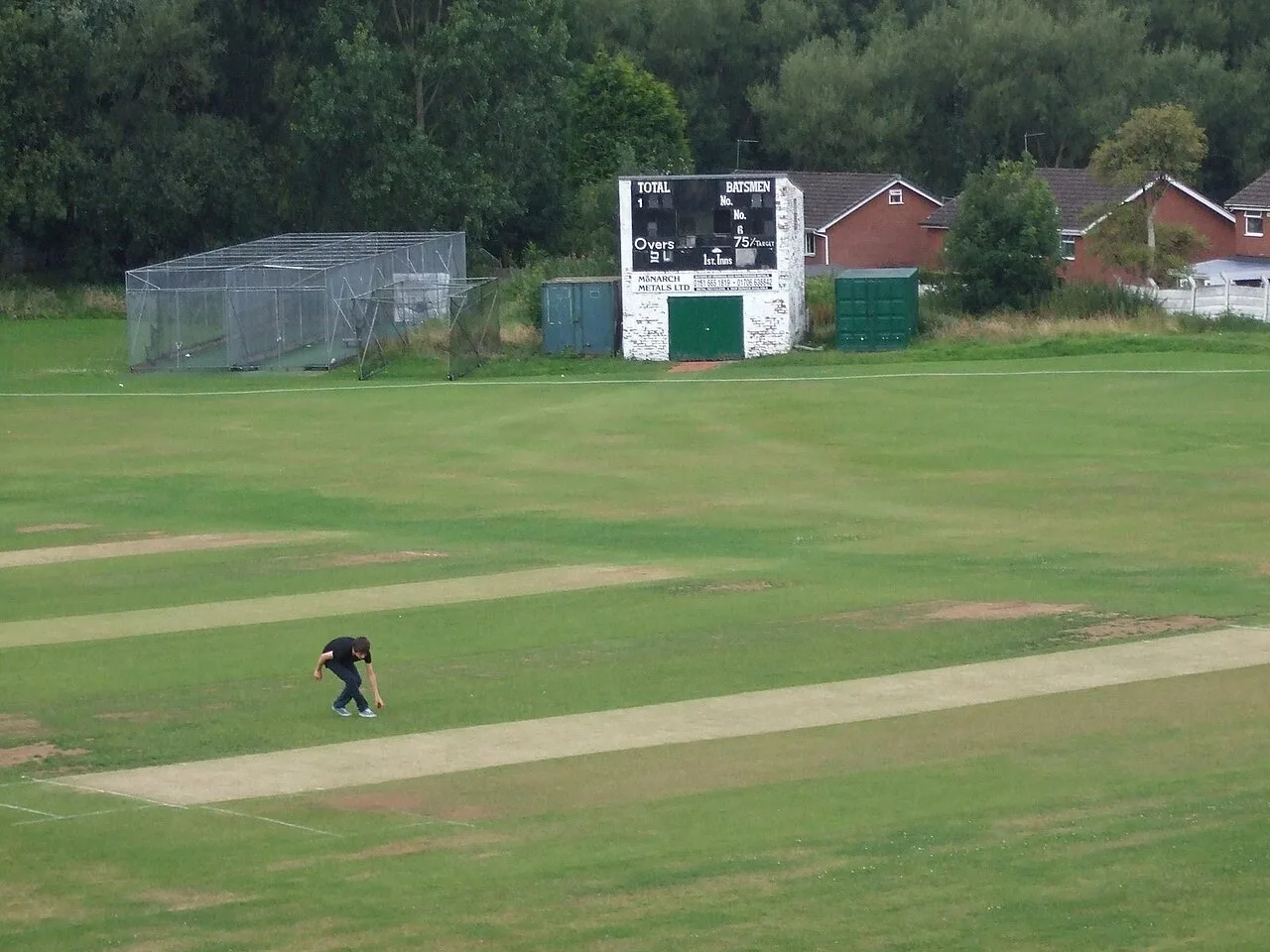
Club scoreboard photographed in 2011, illustrating how runs, wickets and overs describe an innings.
Batting figures show runs and balls faced, while bowling figures show overs, runs conceded and wickets credited under scoring rules. Extras, partnerships and dismissal descriptions fill important gaps. A useful match review combines those entries instead of reducing an innings to the leading scorer's boundary count or the most dramatic wicket.
Strike rate is runs per hundred balls faced. In a hypothetical innings, 30 from 20 balls produces a strike rate of 150. It describes pace, but not the entire value of the innings. Entry position, target, partners and the phase of play influence whether that pace met the team's needs.
Economy rate describes runs conceded per over under the scoring treatment, while wicket figures describe dismissals credited to the bowler. These are complementary measurements. A bowler can apply pressure without taking a wicket, and a wicket-taking spell can still concede heavily. Read when the overs occurred before comparing two bowlers' numbers.
Dismissal details also matter. A run-out is a team fielding event and is not credited as a bowler's wicket. A catch credits the dismissal according to the scorecard, but the surrounding play can include a difficult fielding contribution that the raw bowling line does not describe. Note observed moments with their over and score so another viewer can locate them.
What changes when rain or an interruption affects play?
An interruption can change the available overs, the target or the official result method. Wait for the announced match status and revised conditions before recalculating the chase. A shortened innings cannot always be interpreted by multiplying its early scoring rate, and a rain stoppage is not automatically an abandonment.
The Duckworth-Lewis-Stern method, commonly labelled DLS, belongs to the official limited-overs adjustment process. Readers should distinguish a par score at a stoppage from an announced target for resumed play. The broadcast may display both at different moments. Copy the label as well as the number so the comparison does not change meaning when shared.
For practical notes, record the time play stopped, the innings score, the remaining resources and the subsequent official update. If play resumes with fewer overs, start a fresh requirement line. Retaining both the original and revised figures makes the sequence understandable without leaving an outdated target at the top of your match summary.
A delay can also affect a viewer's schedule without changing the game rules yet. Separate a proposed restart from a confirmed resumption. Ground inspections, weather checks and announcements have different statuses. If a final result is not available, label the match interrupted or awaiting confirmation rather than supplying a predicted outcome merely to complete a report.
How do you distinguish a final result from an incomplete update?
A final result follows the official completion or termination of the match under the applicable rules. A score at the innings break, an apparently winning moment or a delayed live feed is not equivalent to that result. Check the completed scorecard and match status before writing a definitive headline or sharing the margin.
Result wording depends on the situation. A successful chase is commonly expressed by wickets remaining, while a side defending a total commonly wins by runs. An adjusted match may add a method label, and a tie or no-result requires its own wording. Preserve the official form instead of forcing every outcome into one sentence pattern.
The player-of-the-match award and your assessment of the decisive contribution can differ. Report the award as an official designation and support a personal assessment with evidence. A superb spell may create the opening for a chase, while a finishing partnership receives the most attention. The scorecard and observed sequence allow both contributions to be discussed fairly.
Before comparing records, define the statistical category. T20I figures are international short-format figures, while franchise T20 records include a different set of matches. ODI and Test milestones should remain separate as well. A social post that combines categories can make a real achievement appear larger or different from the specific record actually reached.
What should a clear post-match summary contain?
A clear summary gives the date, format, venue, official result and two or three evidence-based turning points. It explains how the match changed rather than narrating every ball. Readers should be able to distinguish confirmed scoring information, tactical interpretation and the writer's opinion without needing access to the entire broadcast.
Write the result sentence first, then describe the main batting and bowling tasks. For example, an invented match report could explain that early wickets forced a rebuilding partnership before a late acceleration. Such a sentence needs the actual entry score, partnership sequence and final overs from the relevant scorecard before it becomes a factual report about Afghanistan or Zimbabwe.
Choose turning points by their effect on the task. A dropped chance may matter if the surviving batter later changes the chase; a quiet over may raise the requirement enough to force risky shots. Avoid assuming every wicket had equal importance or every six changed the match. Explain the mechanism with the score and phase attached.
Finish by preserving the boundary between one game and the wider series. One win might level a programme, secure it or leave it undecided, depending on completed results and matches remaining. If you have only verified the individual fixture, report that fixture confidently and leave the series conclusion until the full schedule and outcomes have been checked.
Your reusable viewing worksheet
A compact match notebook can have four lines per phase: score and overs, resources, requirement and observed decision. During the first innings, the requirement line becomes the likely scoring task you are investigating, clearly marked as interpretation. During the chase, it becomes the actual runs and balls equation. This consistent structure makes comparisons easier while preserving the different demands of batting first and second.
After the game, select one claim you made while watching and test it against the completed record. Perhaps you thought a team was rotating strike well or wasting its bowling resources. Count the relevant evidence before keeping the claim. Revising an early impression is a strength of match analysis, because live viewing naturally offers incomplete information and selective camera coverage.
Keep the worksheet small enough to use consistently. Recording every available statistic can distract a beginner from the basic contest between scoring, wickets and time. Once those foundations are clear, add one new measure, such as boundary frequency or partnership length, and ask whether it improves your explanation of this particular match.
For the wider programme, use the Afghanistan and Zimbabwe series guide. For a player's combined contribution, see the Sikandar Raza analysis guide. The spin-bowling guide adds a focused exercise for interpreting a spell.
Sources
Source 1 Source 2 Source 3 Source 4
Image credits: Cover: Sanober Ahmed, source, CC BY-SA 4.0. Resized and converted to WebP. Article image: BatAndBall, source, CC BY-SA 2.0. Resized and converted to WebP.
Found an error or an outdated detail? Report a correction with the article URL and original source.