
Australia Cricket Team: Formats, Squads and Fixtures
Follow Australia’s cricket team through the correct format, official fixtures and squad announcements, and learn how to interpret team performance.
To follow the Australia cricket team accurately, identify the team category and format before reading the fixture, squad or result. Australia's men's, women's and age-group programmes are separate records, and Test cricket, ODIs and T20Is create different tactical demands. The official match centre is a starting point for locating the particular game you want to understand.
This guide explains the team-level questions behind a cricket headline: which side is playing, what the announced squad means, how the schedule translates for Pakistan viewers and what a completed match says about performance. It uses hypothetical examples for calculations rather than inventing a live fixture, captain, ranking or playing eleven.
Which Australia team does a fixture actually identify?
Read the full team label, competition and opponent before treating a match as part of Australia's senior international record. A country name on a score graphic can refer to a men's, women's, development or age-group side. Domestic teams also appear in national cricket coverage, so the publisher's identity alone does not establish international status.
Create an identity line containing both sides, the format, competition, venue and match date. Add the team category explicitly. This is especially useful when a short clip or social post leaves out part of the title. The same opponent can play Australia in several categories and formats during different tours.
Distinguish a representative development side from a full national team. A strong performance may be relevant to player development without counting as a senior international appearance. Keep competition records in their own categories rather than combining every match involving Australian players into one apparent national winning streak.
For a school sports report, write the full label at first mention, then use a shorter name consistently. If the available source does not identify the category, find the original fixture page before publishing a conclusion. Correct identification is the foundation of every later statistic, because a perfectly calculated average is misleading when attached to the wrong set of matches.
How do Tests, ODIs and T20Is change team strategy?
The formats differ in available time, innings structure and playing conditions, so team balance and acceptable risk change with them. Tests allow a longer contest across innings, while standard ODIs and T20Is provide a limited allocation of overs. Consult the competition's current playing conditions for details and for any reduced-overs arrangement.
In a Test, batting time can help a team build a position or avoid defeat. A bowler's contribution may include sustaining pressure across a spell rather than seeking a wicket with every delivery. A declaration, follow-on decision or new-ball choice belongs to a longer strategic horizon than a short limited-overs chase.
In an ODI, a team has to distribute batting and bowling resources across a defined innings. The balance between early wickets, middle-overs control and late acceleration matters. In a T20I, fewer available deliveries can make each scoring opportunity more urgent. That does not mean every aggressive stroke is sensible; the field, matchup and wickets remaining still matter.
Avoid transporting a statistic without its format. A batter's Test average and T20I strike rate answer different questions. A team's good record in one competition does not automatically predict its next series in another. Compare performance within a defined format first, then explain any broader argument with evidence rather than relying on the national team's reputation.
How should Pakistan viewers convert Australian match times?
Use the venue city, match date and stated timezone to convert a start time. Australia has multiple time zones, and daylight-saving arrangements are not uniform. A single fixed “Australia to Pakistan” offset is therefore unreliable. Check whether the fixture page already displays your local time before converting it again.
Record the date as carefully as the hour. A conversion can move an event across midnight, changing the calendar day for a viewer. If a schedule says “local time,” identify whether that means venue time or the device's local setting. A screenshot shared by someone abroad may display a different conversion from the one you need.
For a purely hypothetical example, if a verified venue offset were UTC+11 and the start were 14:00, Pakistan's UTC+5 would make the corresponding time 08:00 on that date. The arithmetic uses a six-hour difference. The essential step is verifying the offset for the actual city and date, rather than assuming that example applies to every Australian venue.
Build a viewing reminder only after checking the latest fixture status. Weather, operational decisions or schedule revisions can alter arrangements. Keep the original source and the time you checked it in your notes. If planning travel, verify ticket and venue information separately; a fixture listing does not by itself establish admission rules or transport arrangements.
What is the difference between a squad and the playing eleven?
A squad is the selected group available under the announcement's terms; the playing eleven identifies the team chosen for a particular match. A squad can include alternatives for conditions, balance or availability. Treat a predicted lineup as prediction until an official team announcement or match record establishes who actually plays.
Read the scope of a selection notice. It may cover an entire tour, one format or only part of a series. A replacement announcement can change the available group later. Record its date and which earlier statement it updates. This is more reliable than assembling a “current squad” from several undated profile pages.
An omission does not automatically mean injury, disciplinary action or retirement. Those are separate claims needing specific evidence. Likewise, selection in a squad does not guarantee an appearance. A player may provide cover or compete for a role without entering the final team. Describe the confirmed selection action rather than guessing a private explanation.
Think in roles before names
List the team's required functions: opening batting, middle-order batting, wicketkeeping, spin, pace and any all-round contribution. Then consider how the selected players cover those functions under the match conditions. This makes a selection discussion more useful than replacing names according to personal preference without explaining the effect on team balance.
How can you analyse an Australian batting innings as a team?

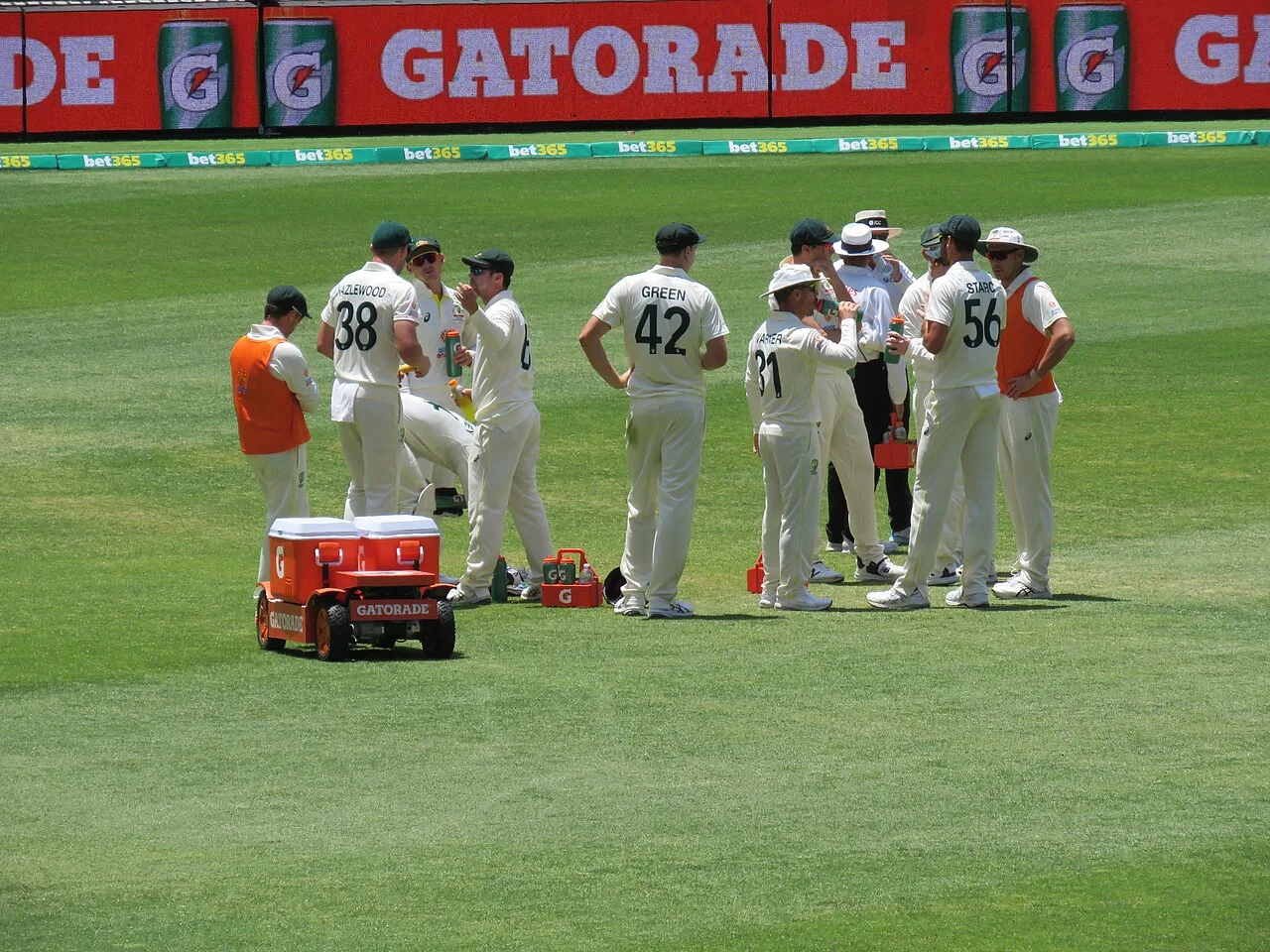
This 2019 view of the Melbourne Cricket Ground illustrates the importance of identifying the venue when reading fixtures.
Track partnerships, wickets and scoring phases rather than treating the highest individual score as the whole story. The team innings depends on how batters share resources and respond to the situation. Use the entry score, remaining overs and target to explain why a contribution matters, then support the argument with the completed scorecard.
A partnership can provide stability even when neither participant finishes with the largest score. Conversely, a fast individual innings may leave a demanding task if wickets fall around it. Explain how runs and wickets developed together. A score timeline usually tells that story more clearly than listing the top three batters without context.
Distinguish batter runs from extras and partnership totals. If you calculate run rate, use legal balls correctly: an over notation such as 12.3 means twelve overs and three balls, not twelve point three decimal overs. That is 75 legal balls, or 12.5 overs for the calculation. Misreading notation can distort both scoring and bowling comparisons.
When comparing two innings, account for conditions and match state. A chase may end before the full allocation is used, while a first innings has a different objective. Revised targets require their own official context. Avoid evaluating a reduced-overs match against an unadjusted full-length expectation simply because both are listed under the same format.
What does a bowling scorecard reveal about team balance?
A bowling scorecard records workload and outcomes, but tactical meaning comes from when and how the overs were delivered. Examine wickets, runs conceded, economy rate and phase of use together. Opening, middle and closing overs can present different problems, so a single economy figure should not be treated as a complete assessment.
Consider a hypothetical bowler asked to defend a boundary-heavy final passage. Their figures might look more expensive than those of a teammate used during a quieter phase. That does not establish superior performance by either player. Compare the opportunities, field restrictions, batting intent and wicket-taking contribution before reaching a conclusion.
Team balance includes options, not merely the nominal number of bowlers. An all-rounder can change how overs are distributed; a specialist spinner can provide a different problem from a pace bowler. Whether the option was useful depends on the match, not on a universal rule that one particular combination always succeeds.
Fielding belongs in the analysis. A saved boundary, a missed chance or a run-out can change a bowler's recorded result without appearing fully in their figures. Describe verified incidents rather than estimating invisible runs saved. A team report becomes stronger when it recognises these interactions and avoids blaming or praising a bowler solely through one statistical column.
| Team question | Record to inspect | What it can establish |
|---|---|---|
| Who was available? | Dated squad announcement | The announced selection group |
| Who played? | Confirmed team and scorecard | Match participation |
| How did batting develop? | Partnerships and scoring sequence | The progression of runs and wickets |
| How were overs shared? | Bowling card and timeline | Workload and recorded outcomes |
| Where does the team stand? | Correct competition table | Position under that table's rules |
How do rankings differ from tournament standings?
Rankings and tournament standings are separate systems. Rankings evaluate teams under the responsible body's methodology, while a tournament table orders participants according to that event's rules. A high ranking does not automatically place a team at the top of a particular group, and a group lead does not establish the highest global ranking.
Always identify the format, category and date of a ranking. An undated screenshot may describe an earlier period or another team category. If you discuss movement, compare two dated versions under the same system. A change in position can result from other teams' results as well as Australia's own match.
Tournament standings may use points, wins and tiebreak procedures. Read the event's regulations rather than assuming that every competition uses an identical net run rate calculation or qualification rule. An abandoned match can have a different table consequence from a completed defeat, even when neither produces a win.
Avoid combining records into a fictional universal position. A responsible sentence identifies both the system and its scope. If the position is not necessary to your analysis, omit it rather than copying a current-looking number from an old snippet. Team performance can be explained through a defined set of completed matches without claiming an unverified live standing.
What should a good Australia match report explain?
A useful report explains the contest's central problem, the turning points and how team decisions affected the outcome. Begin with the verified result and match identity, then choose evidence that explains the result. Keep selection speculation, future predictions and personal reactions separate from what the scorecard and footage actually establish.
Choose two or three turning points with clear reasons. A partnership might have repaired early damage; a bowling change might have interrupted acceleration; a fielding event might have altered a chase. State the situation before each moment and its consequence after. This makes the report causal enough to be interesting without inventing intentions.
Build a simple team worksheet
Use one page with match identity, batting phases, bowling allocation, fielding incidents and final interpretation. Attach a source to every numerical claim. Where footage is edited, mark the missing interval rather than describing it as if you watched it. A precise limitation is useful because it tells another reader which part of the explanation can still be tested.
End with a conclusion about that match or defined series, not a permanent verdict on the whole national programme. If discussing a future fixture, present the question the next match may test rather than predicting a result as fact. This approach helps Pakistan viewers and students follow Australian cricket with clearer timing, better terminology and stronger evidence.
Before sharing the report, perform a final identity check across every paragraph. Make sure a women's result has not been combined with a men's squad, a domestic performance has not become an international appearance and a venue time has not been converted twice. These are simple checks, but they prevent errors that detailed tactical writing cannot repair later.
Make the next viewing session purposeful
Choose one team question before the match begins, such as how overs are allocated when an opening spell ends. Record what actually happens, then compare it with the situation that developed. Resist changing the original question halfway through simply to make a preferred player look successful. You can add a second question without discarding the first set of observations.
The cricket qualification guide helps when a result affects progression. Use the ODI scorecard guide for numerical interpretation and the all-rounder analysis guide when examining how one role changes team balance. Keep those tools subordinate to the exact competition being watched, since an explanatory example from another event does not override its regulations.
After the game, write one sentence describing what your evidence changed about your original expectation. That habit encourages observation instead of retrospective certainty. A team can win while exposing a weakness, or lose while executing part of its plan effectively; the record should determine which conclusion is justified.
Sources
Image credits: Cover: Calistemon, source, CC BY-SA 4.0. Resized and converted to WebP. Article image: Dietmar Rabich, source, CC BY-SA 4.0. Resized and converted to WebP.
Found an error or an outdated detail? Report a correction with the article URL and original source.