
Ireland vs Namibia: Read the Full ODI Scorecard
Read an Ireland vs Namibia scorecard accurately, check the match date and innings, and understand partnerships, extras and revised targets.

An Ireland versus Namibia ODI scorecard is easiest to read in layers: match identity, innings totals, batting, bowling and final result. Begin with the fixture date and match number so that an older meeting is not mistaken for today's game. Then use the rows as parts of one accounting record rather than as unrelated player statistics.
The boards' material confirms an October–November 2026 men's ODI tour in Windhoek. This article teaches scorecard reading rather than reporting a changing live score or inventing the outcome of a particular fixture. Every numerical score used below is a hypothetical exercise and should not be attached to Ireland or Namibia's real results.
Which part of the scorecard should you read first?
Read the match header and innings summary before individual batting or bowling rows. Confirm the teams, format, venue, date and status. Then identify which side batted first, which innings is displayed and whether the record is live or completed. This prevents a plausible number from being interpreted in the wrong context.
A fixture page may show a scheduled start, a current innings and a final result in different places. The most prominent panel is not always the final outcome. Look for an explicit status and the official result wording.
An innings total such as a hypothetical 247 for eight describes team runs and wickets lost. It does not mean every batter was dismissed or that the side won. In an ordinary uninterrupted one-innings chase, the opposing side would need one more than the first total, but any revised target must be checked separately.
The number of overs shows how much of the allocation has been used, not necessarily how much playing time has elapsed. A rain delay, drinks break or slow over can make elapsed clock time very different from the progress represented in the score.
Keep the header attached when sharing a screenshot. Cropping away the date or innings label can turn an accurate image into misleading information even when none of its numbers have been altered.
How do overs become legal balls and rates?
Convert overs into legal balls before calculating rates or remaining deliveries. In standard six-ball overs, the number after the point is a count of balls within the current over, not a decimal fraction. This distinction affects current run rate, economy and the chase equation.
A hypothetical 24.3 overs means 24 multiplied by six, plus three: 147 legal balls. If the team has 123 runs, current run rate is 123 divided by 147, multiplied by six, or approximately 5.02 runs per over.
In a fifty-over innings, the usual allocation is 300 legal balls unless conditions change it. At 24.3, that leaves 153 legal balls, equivalent to 25 overs and three balls. Subtracting 24.3 from fifty as an ordinary decimal gives the wrong interpretation.
Required run rate uses runs still needed and balls remaining. If a hypothetical side needs 90 from 72 balls, it needs 7.5 runs per over. If the next over brings six, the remaining equation becomes 84 from 66, approximately 7.64 per over.
Do not count wides and no-balls as completed legal deliveries. They can add runs and extend the sequence of deliveries within an over. A commentary over containing seven or eight entries is therefore not automatically a scoring error.
Keep exact balls until the end
Use the legal-ball count in calculations and round only the final rate. Repeatedly converting between rounded decimal overs and ball notation can introduce errors. A small scratch calculation is often clearer than trusting a calculator's default decimal format.
What do the batting columns tell you?
Batting columns show individual runs, balls faced, boundaries and scoring rate, with dismissal information indicating how the innings ended. Read those fields together. They describe the recorded contribution, but they do not by themselves explain the entry situation, delivery quality or value of the partnership.
Runs are not the same as balls faced. A hypothetical 42 from 50 balls gives a strike rate of 84. If the batter hit four fours and one six, boundaries contributed 22 runs, leaving twenty from other scoring strokes. This check helps connect the columns.
Fours and sixes count boundary events credited to the batter. They should not be treated as the team's complete boundary total without checking other batters and extras. The total innings contains more than one person's scoring.
Not out means the batter was not dismissed in the recorded innings. Did not bat means no batting appearance occurred. Retired hurt has a distinct meaning and should not be converted automatically into a normal dismissal for an average calculation.
A blank dismissal field may reflect an incomplete display or a special status. Read the actual label and match report. Guessing that every blank means not out can distort both the individual record and any later statistical summary.
How do extras and partnerships fit into the team total?
Extras belong to the team total but are not all credited to batters or charged to bowlers in the same way. Partnerships include the team's scoring while a pair is together, including applicable extras. These distinctions explain why adding only individual runs may not reproduce the innings total.
The extras panel can include byes, leg byes, wides, no-balls and penalty runs. Each category has its own scoring treatment. Read the breakdown rather than treating the combined extras number as one kind of bowling error.
Suppose hypothetical batting scores add to 230 and extras total seventeen. The innings total should be 247. If the panel shows another number, check whether a row is missing, a score is still updating or an unusual adjustment is explained in the commentary.
A partnership of 70 does not necessarily mean one batter made 35 and the other made 35. They may contribute different amounts, and extras can add to the stand. Avoid assigning equal credit simply because the total is shared.
Fall of wickets records the team score when dismissals occurred, often with the over and batter identified. Consecutive entries can help reconstruct scoring between wickets, but special situations require care. Use any explicit partnership panel and retirement notes before assuming the difference always describes an ordinary uninterrupted stand.
| Scorecard field | Meaning | Check to make |
|---|---|---|
| Team total | Batting runs plus extras | Add the relevant categories |
| Batting row | One batter's recorded innings | Read status and balls separately |
| Partnership | Team runs during a pairing | Include extras and unequal shares |
| Fall of wickets | Team position at dismissals | Match the sequence and labels |
| Extras | Non-batter scoring categories | Check the breakdown |
How should you interpret bowling figures and dismissals?
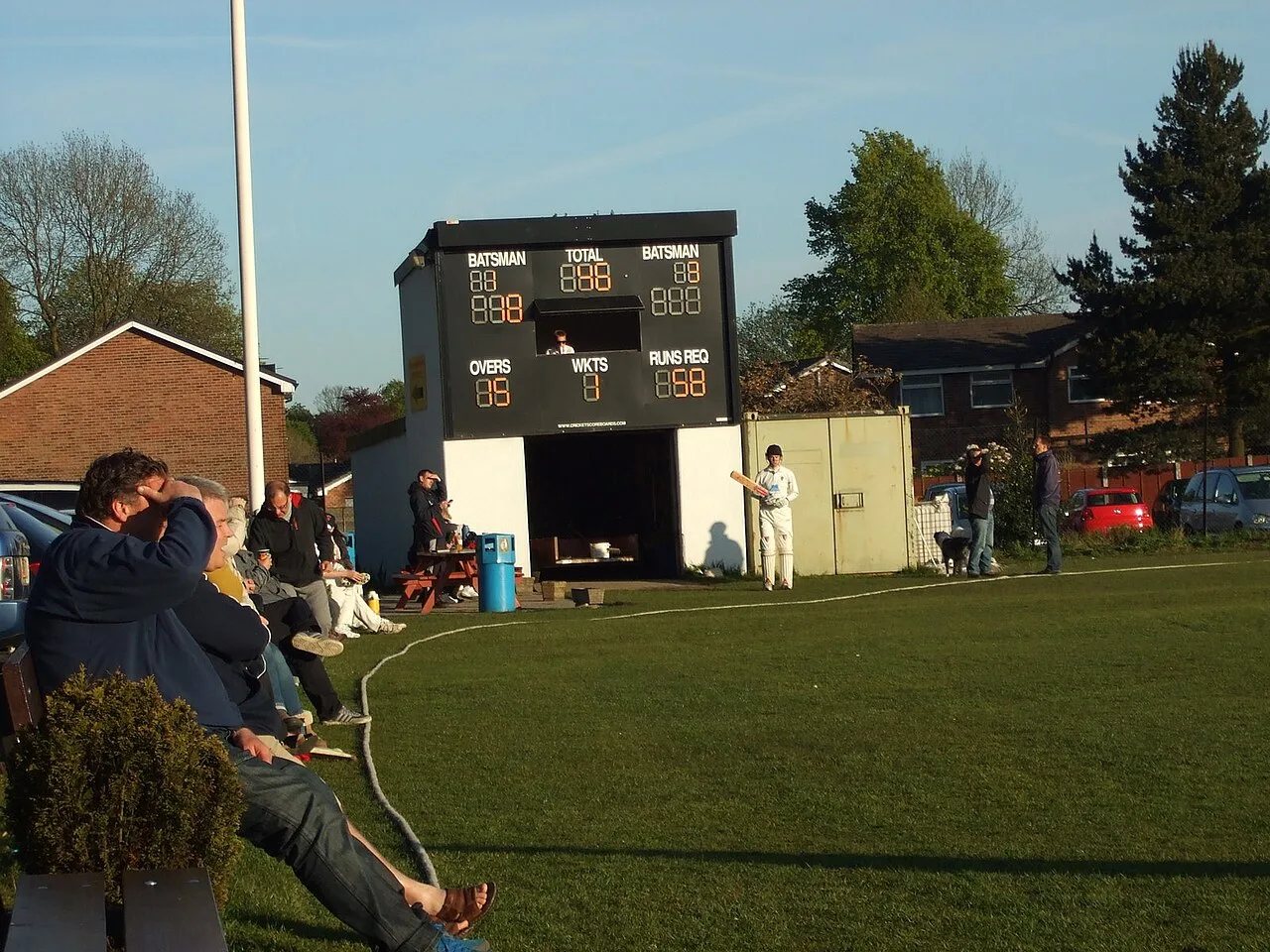
A Bury club scoreboard photographed in 2012 provides an illustrative totals-reading exercise; it is not an Ireland–Namibia score.
Read overs, maidens, runs conceded and wickets using the displayed labels, then inspect how each dismissal was recorded. A bowler's wickets are not the same as all team dismissals. The bowling panel measures a defined contribution and needs fielding and match context for a fuller interpretation.
A hypothetical spell of 8.2 overs contains fifty legal balls. If the bowler concedes forty runs, economy rate is 4.8 per over. Using 8.2 decimal overs instead would produce an incorrect result.
A maiden concerns runs charged to the bowler during a completed over under scoring conventions. It does not prove that the entire spell was economical, and the final number should still be read with conceded runs and allocation.
Caught, bowled, lbw and stumped describe distinct dismissal types, while a run-out is not credited as a bowler's wicket. A team can therefore lose ten wickets without those ten appearing in the combined bowling wicket column.
For a caught dismissal, the named fielder completed the catch, but the label does not show its difficulty. Commentary or video can add that context. For a run-out, the record may identify more than one fielder involved in gathering, returning and breaking the wicket.
Do not subtract a dropped catch from the official runs or add an imaginary wicket to improve a spell. The recorded figures remain the record. Discuss the missed opportunity separately so the interpretation stays honest.
What changes after rain or an interrupted chase?
After an interruption, use the officially announced allocation and revised target. The original first-innings total may no longer define the chase in the ordinary way. DLS considers available resources, so simply matching the earlier scoring rate is not a reliable way to calculate the official requirement.
A par score and a target are different labels within the method's use. Do not assume a displayed par figure is the number required to win. Read the graphic carefully and consult the recorded result when the match has ended.
Further rain can produce another revision. A screenshot captured before the second change may remain accurate for its original moment while no longer describing the current task. Timestamp and innings allocation help explain the difference.
Minimum-play requirements and completion conditions depend on the relevant competition rules. Avoid applying a remembered rule from another format or tournament. The officials' decision and applicable playing conditions determine whether a result is possible.
If the game is abandoned or produces no result, record that status rather than awarding victory to the side that looked stronger before interruption. A hypothetical advantage is not an official outcome, and a projected score is not a completed innings.
Keep the chronology
Write down the original allocation, interruption and announced revision in order. This small log can make a complicated scorecard readable without reproducing every commentary entry. It also prevents an older target from appearing beside a later innings total.
How do you read the result margin and series score?
Read the final result line as its own statement, then separate it from the series score. A result margin describes the completed match under the applicable conditions. A series score summarises a group of matches and may remain unresolved even after one team wins an individual game.
A win by runs generally describes a successful defence of a target, while a win by wickets describes a successful chase with batting wickets remaining. The official wording should be retained, especially where a revised method or unusual condition is mentioned.
A tie is not the same as no result. A tied score under completed conditions can lead to further procedures if the competition provides them, while no result concerns a different outcome. Do not invent a tiebreaking procedure from a different event.
To check a simple hypothetical runs margin, compare the first total with the completed chasing total. If the first side makes 247 and the second finishes at 240 in an ordinary completed chase, the difference is seven. Do not subtract the target of 248 and report eight.
For a series table, record each fixture once, with its date and status. A duplicate entry or an abandoned match treated as a win can distort the tally. Confirm the competition's structure before claiming that one result settles the whole series.
How can you reconcile the whole scorecard?
Reconciliation means checking whether the panels agree under the scoring rules. Add batting runs and extras, convert overs into legal balls, compare bowling allocations and match dismissals to the wicket records. The aim is to identify missing context or a calculation error, not to assume every apparent mismatch proves a faulty scorebook.
Begin with the simplest check: batting runs plus extras should match the team total, allowing for the complete official record. Then add the legal balls in each bowler's allocation and compare them with innings overs. Exclude illegal deliveries from the completed-ball count.
Next, compare team dismissals with credited bowler wickets and non-bowler dismissals. Check special labels before forcing every departure into the same category. A retirement can affect the visible batting sequence without behaving like an ordinary wicket.
Bowling runs should be reconciled with the relevant extras treatment, not blindly equated with the total. If the difference remains unexplained, read the notes for penalties or corrections. A live display may also update panels at slightly different moments.
A complete classroom exercise
Create a deliberately small hypothetical innings with three batting scores, a clearly marked unfinished batter, an extras breakdown and two bowling allocations. Give one student the batting panel and another the bowling panel. Ask them to assemble a consistent team summary and explain any missing information.
Then add a run-out and one wide to the exercise. Students should revise the wicket allocation and legal-ball count correctly without simply changing the team total until it looks plausible. This tests understanding of categories rather than memorisation of abbreviations.
Finish by writing a four-sentence match note: identify the fixture, describe the innings pattern, explain the chase or defence and reproduce the official result. Every number in the note should come from the scorecard or an explicit calculation.
For Ireland and Namibia coverage, this method keeps a real fixture anchored to a reliable record while leaving live developments to the current match page. It also gives a reader the confidence to recognise a misleading screenshot, explain an apparent mismatch and discuss cricket with more than an isolated score.
For a run chase viewed from the batter’s perspective, compare the middle-order innings guide. The bowling figures explainer adds detail on evaluating spells, while the fixture-identification guide helps when search results mix dates and categories. These companions address interpretation around the accounting exercise; keep the official scorecard as the record of what happened.
Sources
Source 1, Source 2, Source 3, Source 4
Image credits: Cover: w:de:User:Chtrede, source, CC BY-SA 4.0. Resized and converted to WebP. Article image: BatAndBall, source, CC BY-SA 2.0. Resized and converted to WebP.
Found an error or an outdated detail? Report a correction with the article URL and original source.