
Emma Corrin: Understanding a Screen Performance
Explore Emma Corrin’s screen work through performance analysis, production credits and media literacy, with a simple scene-study exercise.

Emma Corrin's portrayal of Lady Diana Spencer in Season 4 of The Crown provides a useful starting point for studying screen performance and historical drama. The role was announced by Netflix on 9 April 2019. That casting announcement establishes a production credit; it does not certify that every exchange in the drama is a documentary record of a private conversation.
A careful performance study asks two related questions: how the production makes a character understandable, and what kind of evidence supports its representation of history. This guide concentrates on those questions through a scene-by-scene method. Its suggested exercises use hypothetical situations rather than claiming that a particular gesture or line occurs in an episode that has not been examined here.
What should you identify before analysing Emma Corrin's work?
Identify the production, season, episode and scene before describing a performance. Corrin's Season 4 role should not be confused with another actor's portrayal in a later period of the series. A correct name attached to the wrong footage can undermine an otherwise thoughtful review.
Start with the production credit and then locate the scene you will analyse. Record a timestamp or a clear sequence description, such as the conversation immediately before a named event. This makes your evidence inspectable and prevents a compilation of unrelated clips from becoming an apparently continuous performance.
Use an authorised viewing source where available and check the age classification for the intended audience. A scene suitable for an adult film-studies discussion may need a different approach in a school setting. Choose the material for the learning question rather than assuming that historical subject matter makes every scene appropriate.
Write down what you already know or expect. Familiar photographs, interviews or earlier portrayals can shape your response before the scene begins. Recognising that prior knowledge does not invalidate the response; it helps you avoid crediting the screen performance with information supplied by your own memory.
A practical first note should contain the scene context and one question, perhaps how a character manages an uncomfortable public encounter. That keeps the analysis focused. For a broader contrast between stage and screen methods, the Patrick Stewart performance guide offers a complementary exercise in language and scale.
How is a historical character different from the real person?
A dramatic character is constructed through a screenplay, performance and production choices, even when based on a real person. The real individual's life includes evidence and experiences beyond what the drama can show. A convincing portrayal therefore needs to be assessed as representation rather than treated as direct access to private thoughts.
Separate three kinds of statement. A documented public event concerns the historical record. A scene's dialogue belongs to the production unless independently established. An interpretation of what a pause suggests belongs to the reviewer. Mixing those categories makes a review sound factual at precisely the point it becomes speculative.
A useful example is a hypothetical private conversation before a public appearance. An archive may establish that the appearance occurred and show its setting. It may not establish the exact words exchanged beforehand. A dramatisation can imagine that exchange to express conflict, but the scene itself cannot serve as evidence that the conversation happened.
Costume and period setting can increase visual familiarity. That familiarity can make invented dialogue feel authenticated by the surrounding detail. Ask what each element actually supports. An accurately reproduced outfit may support a claim about design research while leaving the private conversation unverified.
You do not need to reject historical drama to read it critically. Its power can lie in exploring possible experiences and relationships. The important task is to state when you are discussing the production's version of a person and when you are making a claim about the historical individual.
Which acting choices deserve close attention?
Look at how a character pursues an objective through voice, posture, gesture and responses to a scene partner. The strongest analysis describes a change rather than compiling mannerisms. Ask what the character wants, what obstacle prevents it and how the tactic develops during the exchange.
For a hypothetical example, imagine someone trying to leave a formal gathering without causing offence. A brief smile, a glance toward the door and a carefully softened request may work together. The behaviour becomes meaningful through the objective, rather than because a glance universally signifies anxiety.
Listen to pace and accent without reducing the performance to imitation. Resemblance can be one part of a portrayal, but timing and responsiveness also shape character. A review that merely says an actor sounds like the historical person overlooks how the scene's argument and emotional direction are communicated.
Watch the eye line. A character looking at a partner, an observer or a camera inside the story can have different implications. Establish what is actually visible before interpreting it. A reaction shot may show the result of another person's words, but editing determines when that reaction appears to the viewer.
Distinguish the choice you observe from the feeling you infer. “The reply comes after a silence” describes timing. “The silence suggests hesitation before accepting the invitation” is a reading supported by context. That small separation allows a thoughtful argument without pretending to measure the character's inner state directly.
How do framing and editing change what you see?
Framing determines what enters the image, while editing connects shots in a particular order and rhythm. Those choices shape how an actor's behaviour is perceived. A close-up can emphasise a small reaction, and a cut away can make the viewer wait for a reply that the performance alone does not control.
Consider an original classroom scene with two people at a table. Film it once as an uninterrupted two-shot and again using alternating close-ups. The spoken words may be identical, but the second version can direct attention toward selected reactions. Compare what each version allows the audience to notice.
A wide view can reveal blocking, distance and unequal access to the space. A closer frame may conceal those relationships while making an expression prominent. Neither is automatically more honest. Ask what information the production includes, excludes or delays at the moment relevant to your argument.
Separate the contribution you are describing
| Visible effect | Performance question | Production question |
|---|---|---|
| A restrained reply feels tense | How is it delivered? | How long does the shot hold? |
| A character seems isolated | What is the posture? | Where are others placed in frame? |
| A conversation feels abrupt | How do replies overlap? | Where are the cuts? |
| A reaction becomes prominent | What changes in the face? | Why is that reaction selected? |
Continuity also matters. A finished sequence may combine different takes. You cannot infer the exact rehearsal process or shooting order from the completed scene. Describe the final screen effect unless a reliable production account establishes how it was assembled.
What roles do costume, lighting and sound play?
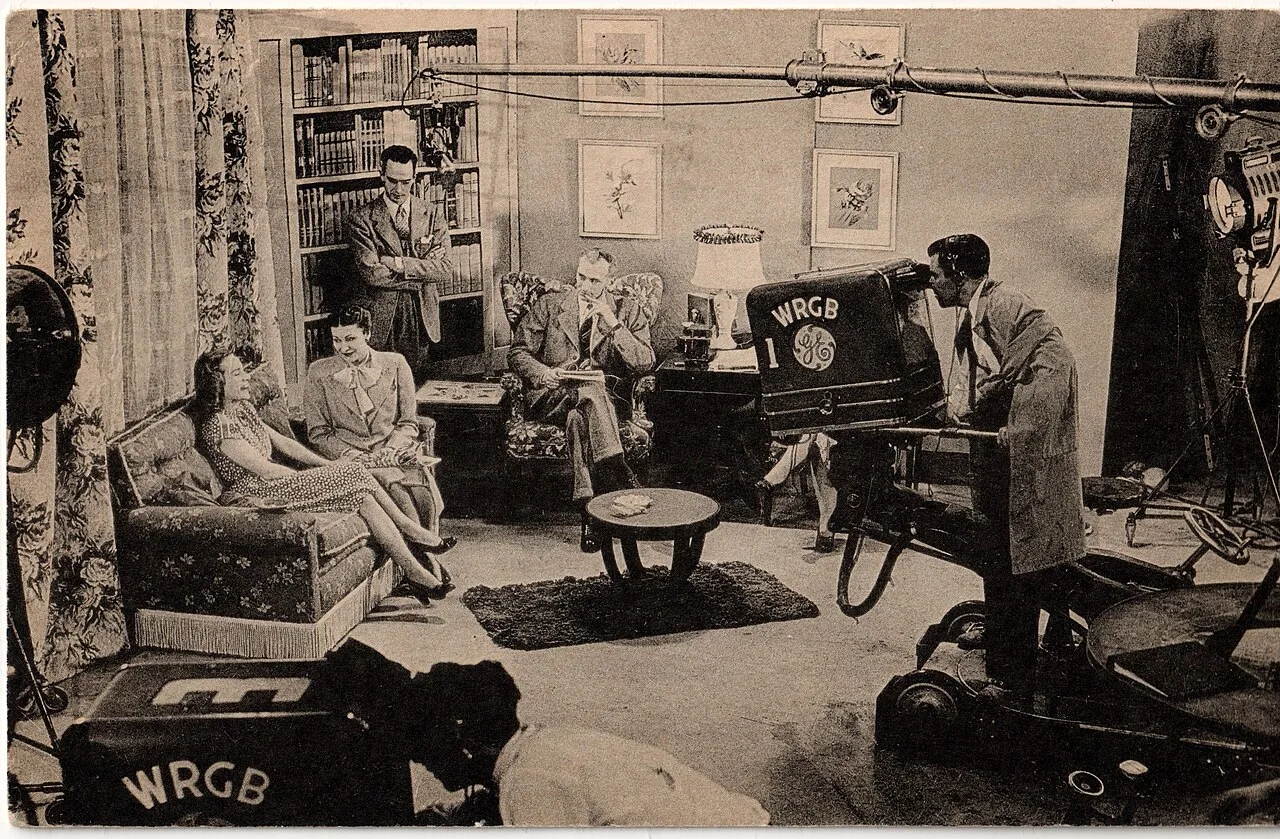
A historical television studio illustrates the production environment behind screen performance; it is unrelated to The Crown's filming.
Costume, lighting and sound design supply information and mood alongside acting. They can reinforce a character's public role, emphasise discomfort or change the apparent scale of a moment. Treat them as collaborating elements rather than awarding the actor sole credit for every effect in the finished sequence.
The production's own costume material identifies different portrayals across seasons and shows how wardrobe contributes to the representation. Use such material to establish a design detail, then examine what the detail does in the scene. A gallery image alone cannot show movement, timing or the full dramatic context.
Imagine a hypothetical character entering a room in formal clothing while others remain casually dressed. The costume contrast can make the character seem conspicuous before any dialogue occurs. The performance might intensify that effect through careful movement, or counter it through ease and confidence. Analyse the relationship.
Sound can similarly influence your response. Music may encourage unease, while room tone and silence can make a pause feel exposed. In a second viewing, attend to what you hear beneath the dialogue. Avoid assuming that a reaction you felt came entirely from the actor's delivery.
For an experiment, use your own short recording and compare it with different background sound. Keep the image unchanged and note whether your interpretation shifts. This teaches the collaborative nature of screen meaning. It also discourages a review from treating a character's apparent emotional state as an isolated product of facial expression.
How can you separate performance analysis from historical accuracy?
Use different evidence for different questions. Performance analysis examines what the scene shows and how it communicates. Historical accuracy requires independent records relevant to the event or claim. A strong review can discuss both, provided it does not use dramatic effectiveness as proof that the depicted exchange happened exactly that way.
Create an evidence sheet with columns for scene claim, production detail and historical support. A public appearance may have archive footage; the arrangement of a private room may have a different basis; an invented conversation may have no direct record. Mark each separately rather than assigning one accuracy label to an entire episode.
Be precise about uncertainty. Saying that a private exchange is not established by the material you consulted differs from declaring that it definitely never occurred. Both certainty and rejection require support. A gap in your research should remain a gap rather than become a new historical claim.
When comparing archive footage and drama, identify differences without assuming every difference is an error. An adaptation may compress time or rearrange encounters for narrative purposes. Explain the effect and the evidential limit. If a production account documents the decision, attribute that explanation; otherwise label your proposed reason as interpretation.
The same distinction is useful in Shivaji Satam and fictional investigation: a persuasive scene can model a process without establishing that real events or institutions operate exactly as shown. Media literacy begins when the viewer asks what type of claim the image can actually support.
What exercises help students analyse without copying dialogue?
Use a short scene, a focused question and paraphrased observations. You can study performance effectively without reproducing long dialogue passages. The aim is to explain the evidence in your own language, using a brief quotation only when a particular word or contrast is essential to the argument.
Begin with a three-viewing exercise. First describe the situation in two sentences. On the second viewing, record three observable performance choices. On the third, note framing, sound and editing. Keep the columns separate before writing about their interaction. This prevents the first emotional response from becoming the entire analysis.
For a practical activity, write an original six-line conversation about declining an invitation. Give one character a public objective, such as remaining polite, and a private concern, such as needing to leave. Perform it twice with different subtext while keeping the words unchanged.
Then change only the camera distance or the placement of the scene partner. Ask observers which version made the conflict clearer and why. Their answers should refer to visible or audible details. “It felt stronger” is a starting response, but it needs an explanation before it becomes analysis.
Keep a record of revisions to your own review. Replace generic praise with precise descriptions, remove unsupported biography and check that the scene evidence supports the conclusion. This is a writing skill as well as a film skill, because it trains you to connect a claim with material another reader can evaluate.
How should a finished Emma Corrin review be structured?
Begin with a limited argument about a specific scene, establish the production context and develop the argument through two or three connected observations. Discuss collaboration where it matters and state the boundary between interpretation and historical claim. A review should help the reader notice more, not merely announce approval.
A useful paragraph sequence is context, claim, evidence and explanation. For example, explain that a conversation concerns a character's ability to choose, describe how the reply is delayed and connect the delay with a shift in the exchange. Keep that example hypothetical until you attach it to a verified scene.
A performance review should also recognise the director's contribution. A montage can compress time through selected images, so it needs a different analysis from an uninterrupted exchange.
A second paragraph can examine a production choice that strengthens or complicates the effect. Perhaps the frame excludes a listener, or the sound continues across a cut. Explain the relationship rather than listing cinematography, costume and music as unrelated accomplishments.
If comparing performers, define the comparison fairly. Different seasons, ages, scripts and situations create different tasks. Avoid presenting a preference as an objective ranking of talent. The Sanjay Dutt character-role guide provides another context for distinguishing a recurring screen impression from the demands of a particular role.
Finish by identifying what the scene analysis establishes and what further viewing might test. A thoughtful review of Corrin can illuminate restraint, responsiveness and the organisation of attention without inventing private-life details or turning dramatic dialogue into historical testimony. The result is a clearer account of screen craft and a more careful relationship with the past.
When revisiting the work later, keep the earlier notes. They reveal whether your point of view changed because of new evidence, broader viewing or a better distinction between the character and the actor.
Sources
Source 1 · Source 2 · Source 3 · Source 4
Image credits: Cover: LucaFazPhoto, source, CC BY-SA 4.0. Resized and converted to WebP. Article image: Unknown author Unknown author, source, Public domain. Resized and converted to WebP.
Found an error or an outdated detail? Report a correction with the article URL and original source.