
Jordan Cox: Batting Roles and Wicketkeeping Context
Study Jordan Cox through batting position, wicketkeeping duties and competition context, and check official team records before comparing performances.

Jordan Cox is described by Essex's official profile as a wicketkeeper-batter and a right-handed batter. Those labels identify skills, but they do not establish the role he performed in every match. To study an innings properly, first identify the competition, batting position, entry situation and whether he actually kept wicket in that game.
This guide focuses on role-based batting analysis and the separate evidence needed for wicketkeeping. It uses hypothetical calculations rather than claiming a current average, selection or score. The aim is to explain how a reader can move from an exciting highlight to a defensible account of what Cox contributed and what the available record cannot show.
What should you confirm before analysing a Jordan Cox performance?
Confirm the full player identity, team, competition, season and match date before reading the numbers. County cricket, franchise cricket and international cricket belong to different statistical contexts. A profile can establish identity, while a scorecard establishes participation and the recorded role in the particular match. Do not merge those two kinds of evidence.
A search result using only Cox can lead to a short clip without a competition label. Recover the complete scorecard and match header before assigning the innings to a career category. The kit, venue or commentator's voice may offer clues, but they are weaker than the competition record. Accurate identification prevents an entertaining moment from becoming a false international statistic.
Squad membership is different from appearing in the playing XI. Likewise, a player listed as a wicketkeeper in a biography may field elsewhere during a match. Look for the team sheet and scorecard notation where available. A general skill label should not become a claim that the player completed a specific keeping workload without match-level evidence.
The wicketkeeping and batting guide uses the same separation between player identity and actual duty. In your notebook, give batting and fielding separate fields. This makes it easier to compare performances fairly when a player bats in similar positions but carries different responsibilities in the field across competitions.
How does batting position change the task?
Batting position affects the likely stage of entry, but the actual match situation determines the immediate task. A top-order batter may face an early collapse or a strong platform; a middle-order batter may rebuild or accelerate. Record the score, wickets and overs at entry instead of judging an innings solely from its place in the order.
Imagine two hypothetical innings beginning at number four. In one, the team is twenty for two; in the other, it is one hundred for two with little time remaining. The same batting position produces very different demands. A period of consolidation may serve the first situation while leaving the second team short of the required scoring rate.
Entry conditions also include the bowling available and the partnership. A new batter can face a returning strike bowler or a change of pace. Record those details where the footage or commentary supports them. Do not invent difficulty from the total alone, since an apparent collapse can involve several causes that a scorecard does not explain.
When writing about Cox, phrase the role through the match evidence: he entered at a particular stage and faced a particular requirement. Avoid permanently labelling him an anchor or finisher from one innings. Roles can change across formats and teams. A useful analysis describes the job performed that day before generalising about a broader skill set.
How should runs, balls faced and strike rate be interpreted?
Runs describe output, balls faced describe opportunity and strike rate relates the two. Calculate batting strike rate as runs divided by balls faced, multiplied by one hundred. Then restore the situation: a target, remaining overs, wickets and partnership can change how useful the same scoring rate is to the team.
In an invented example, thirty-six runs from twenty-four balls gives a strike rate of one hundred and fifty. That does not tell you whether the team needed a faster finish or valued recovery after early wickets. A correct calculation is a starting point for interpretation, not a substitute for knowing the innings requirement.
Compare phases rather than only the final ratio. A batter might begin cautiously, then score faster after becoming established. Another might start quickly and slow when the bowling changes. Their overall strike rates can match while their contributions unfold differently. A ball-by-ball record can reveal those patterns more clearly than an edited sequence containing only boundaries.
The scorecard reading guide explains related columns, while the middle-order batting guide connects numbers with partnerships. Use those concepts to ask a precise question about Cox's innings rather than treating a high rate as automatic proof of good decision-making in every situation.
What do strike rotation and boundary choices reveal?
Strike rotation can help a partnership use scoring opportunities between boundaries, while boundary attempts involve choices about delivery, field and risk. Record singles, twos, dot balls and attacking shots together. A highlight reel can make an innings appear to be uninterrupted hitting because it removes the ordinary deliveries that connect the major moments.
For a practice sequence, label each legal delivery with the batter's response and outcome. A dot ball might be a well-judged leave, a missed scoring opportunity or a ball too difficult to attack safely. The outcome alone cannot distinguish them. Add the delivery's line and length when visible, then explain which interpretation the evidence supports.
Boundary percentage describes one aspect of scoring distribution, but it should not become a universal quality score. Field placement, ground dimensions and the match task influence available opportunities. A player who rotates effectively in one phase may still need to attempt higher-risk shots later. Follow the sequence rather than treating every boundary or quiet delivery as equally informative.
Watch the partnership as a shared activity. Running requires communication and judgement from both batters, while strike management can change who faces a bowler. Avoid assigning an exact value to an unmeasured contribution. It is reasonable to describe a visible quick single or a declined run, but numerical claims about runs “created” need a defined method and evidence.
How do you assess wicketkeeping beyond catches and stumpings?
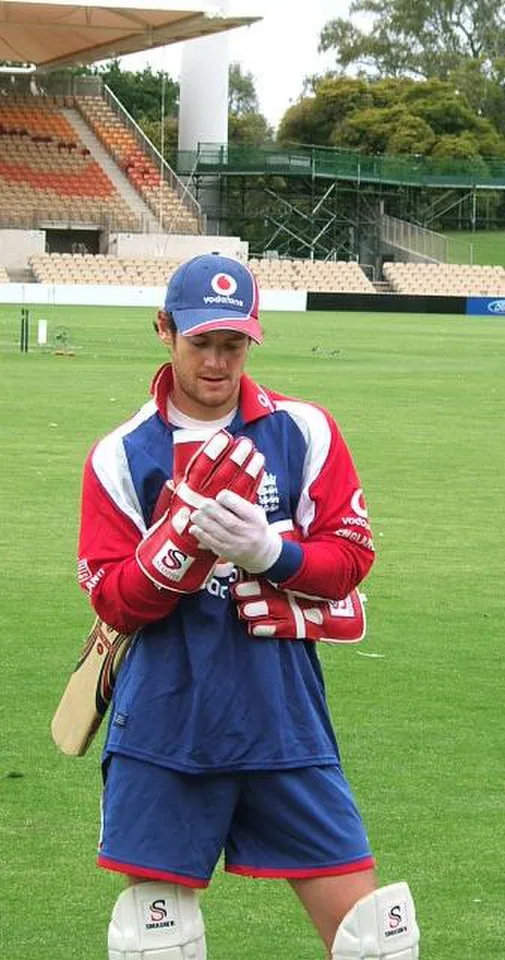
Chris Read practising at Adelaide Oval in 2006 illustrates a keeping movement; the player shown is not Jordan Cox.
Catches and stumpings are recorded outcomes, but wicketkeeping also includes movement, collection, positioning and response to different deliveries. Confirm that Cox kept wicket before evaluating those actions. A dismissal total cannot reveal every clean take, difficult chance or potential chance, so footage and a complete match record serve complementary purposes.
Begin with visible preparation: the keeper's starting position, movement with the delivery and collection point. Compare like situations where possible. Standing back to pace and standing up to slower bowling present different viewing questions. Broadcast angles may obscure footwork or glove position, so leave details uncertain when the footage does not support a confident description.
A missed chance requires context about the ball's path and difficulty. Do not call every contact a dropped catch based on one replay. Likewise, byes do not automatically prove a keeping error; the delivery and circumstances matter. Separate the official scoring outcome from an evaluative judgement about whether a reasonable opportunity was missed.
For a student exercise, choose three visible takes and describe the movement without giving a numerical rating. Then compare a recorded dismissal with a routine collection. The exercise encourages attention to process rather than highlights alone. It also avoids pretending that a viewer can calculate a complete fielding contribution from a broadcast that shows only selected moments.
How do formats and sample size affect comparisons?
Compare performances within a clearly defined format and sample before making broader claims. First-class, List A and T20 records describe different competitions and demands. A small sample can change sharply after one innings. State the period, role and number of opportunities so readers can understand what the comparison can reasonably support.
Batting average uses runs divided by dismissals, which is why not-out innings affect the denominator. A short sample with several not-outs can produce a high average without demonstrating a long record of consistency. This is not a reason to dismiss the contribution; it is a reason to interpret the measure alongside innings, dismissals and match situation.
Do not add a county season total to an international total and present it as one official category. If your question concerns a broader workload, you may discuss several competitions separately. Preserve their labels and dates. The categories can contribute to a narrative about experience without being merged into a statistic that no governing body actually publishes.
For a fair Cox comparison, choose several appearances with a similar role and inspect both successful and unsuccessful innings. Ask whether an observed pattern repeats. A single excellent chase demonstrates what happened in that chase. It does not establish that the player always chases well, just as one low score cannot prove a permanent weakness against a bowling style.
What can a scorecard not tell you about an innings?
A scorecard records important outcomes but cannot fully show shot quality, decision difficulty, running communication or every field change. It also cannot establish private intentions or medical conditions. Use it to anchor the facts, then add only observations supported by footage or reliable match reporting. Keep the difference between record and interpretation visible.
An edge reaching the boundary and a controlled drive can both produce four runs. That does not make the numerical record wrong; it means the record answers a different question from a technical review. A balanced paragraph can acknowledge the runs while explaining the delivery and response. Avoid rewriting the score because you judge the chance differently.
Likewise, a dismissal can follow a useful innings or a poor decision, and sometimes both. Identify the team requirement at the time before deciding how to characterise it. A batter attacking a demanding target may accept risk deliberately, but intention still needs careful wording. Describe the situation that made the risk understandable rather than claiming access to the player's thoughts.
Current selection and injury claims require separate dated evidence. A profile's continued presence does not prove selection for the next fixture, and absence from a scorecard does not establish why the player was unavailable. This guide leaves those changing matters open instead of attaching unsupported news claims to an otherwise educational analysis.
How can you write a balanced Jordan Cox match note?
Write a short note that identifies the match, explains the batting task, summarises the recorded outcome and adds two supported observations. Include wicketkeeping only if confirmed for that game. End with a limitation tied to the available material, such as missing full footage, rather than a generic disclaimer that leaves exaggerated conclusions intact.
Start with a neutral factual sentence. Then explain the entry score and required task using the actual record. In a hypothetical note, a batter arriving during a chase might need both recovery and later acceleration. Divide the innings into phases only if the evidence shows that change. Do not force every performance into the same beginning, crisis and triumph narrative.
Next, describe one scoring choice and one partnership or keeping observation. Connect each with the situation. A useful sentence explains why the choice mattered rather than calling it brilliant. Where the material is incomplete, narrow the claim to the visible sequence. Clear boundaries make the account easier for another viewer to check and harder to misread as a career verdict.
Finally, compare the note with the source record. Check runs, balls, dismissal, competition and fielding role. Remove any statistic that came only from memory or a social caption. A precise analysis can be engaging without forecasting selection, inventing a ranking or assigning an unmeasured total of runs saved. Its value is explaining an observable contribution in the right context.
A role-based comparison
| Evidence | Useful question | Caution |
|---|---|---|
| Player profile | What skills are listed? | Match duty may differ |
| Entry score | What task began the innings? | Position alone is insufficient |
| Strike rate | How quickly were runs scored? | Requirement can change |
| Keeping dismissals | What outcomes were recorded? | Chances vary |
| Full sequence | How did decisions develop? | Intention remains inferred |
Use the table to decide what evidence to collect before starting a comparison. If the question concerns keeping technique, a batting scorecard will not answer it. If it concerns consistency, one highlight will not answer it. Choosing the question first saves time and produces a more useful explanation than collecting many unrelated statistics and hoping they form a conclusion.
Compare two hypothetical chase contributions
Suppose two batters each make forty runs from thirty balls. One enters after early wickets and leaves the side with a stable partnership; the other enters with a strong platform while the required rate rises. Their identical individual figures do not settle which contribution better served the task. Record the changing requirement before making that judgement.
Next, inspect the deliveries available to score from. A quiet period against accurate bowling differs from one containing several missed opportunities. The scorecard anchors the outcome, while footage helps explain the choices. This comparison encourages a reader to ask a better question than simply whether forty at that rate is a good score in every game.
Sources
Image credits: Cover: Sleeper141, source, CC BY-SA 3.0. Resized and converted to WebP. Article image: Blnguyen, source, CC BY-SA 3.0. Resized and converted to WebP.
Found an error or an outdated detail? Report a correction with the article URL and original source.