
Tim Seifert: Keeping and Batting Beyond Highlights
Study Tim Seifert’s wicketkeeping and batting with match context, scorecard checks and a simple observation exercise for cricket learners.

Tim Seifert should be assessed through two separate kinds of work: wicketkeeping and batting. A catch compilation shows only selected outcomes behind the stumps, while a boundary montage leaves out much of an innings. Understanding the wicketkeeper-batter requires attention to positioning, repeated collections, scoring choices and the situation in which each contribution occurs.
New Zealand's archive and Cricket Australia's profile identify Seifert as a wicketkeeping player. This guide explains how to study that dual role without presenting an unverified current team selection or career total. The exercises use hypothetical situations. For any actual appearance, confirm whether he kept wicket, where he batted and which competition the scorecard covers.
What does a keeper do before the ball reaches the gloves?
A keeper prepares through starting position, balance and movement before making the visible take. Those actions determine how much time and reach are available when the ball arrives. Watch the preparation across several deliveries, because a single spectacular collection can conceal either sound positioning or an emergency recovery.
Start by identifying standing back and standing up. Standing back usually provides more reaction distance against pace bowling, while standing up places the keeper closer for a different set of opportunities. The appropriate position depends on the bowler, surface and batter, as well as the legal restrictions governing the role.
Observe footwork after release. Does the keeper move smoothly toward the line, remain balanced and collect without reaching excessively? A quiet take is often evidence that earlier movement solved the problem. It may attract less attention than a dive precisely because the preparation was effective.
Bounce also changes the task. A ball that carries comfortably at one end may arrive lower from the other. Look for adjustment over time rather than expecting an identical crouch and distance on every delivery.
The camera may not show the feet throughout the action. In that case, restrict your observation to what is visible, such as body alignment at collection. Avoid diagnosing a technical flaw from an incomplete angle.
How can you judge catches and missed chances fairly?
Judge a chance through its speed, deviation, height and distance from the keeper's prepared position. A recorded catch establishes a dismissal but does not measure difficulty, while a missed opportunity requires more context than the fact that the ball touched a glove. Use the full sequence whenever possible.
A thin edge against pace bowling may alter the line late. A thicker edge could travel farther but give slightly different reaction time. Slow-motion replay makes both look more manageable than they were in real time, so compare the normal-speed footage before deciding how routine a chance was.
Behind spin bowling, movement off the pitch and changes from the bat can create another collection problem. Watch whether the keeper tracks the ball or has already committed toward an expected line. A difficult take can be completed cleanly even when no wicket results.
Do not invent a conversion percentage from a small set of highlights. To calculate one responsibly, you would need a consistent definition of a chance and a complete record of opportunities. Broadcast editors choose memorable events, not a neutral sample.
Separate opportunity from execution
Record the opportunity first, then the movement and result. This creates a fair comparison between two chances. It also prevents a spectacular-looking dive from automatically receiving more praise than a quieter, better-positioned catch.
What is the difference between a stumping and a run-out?
A stumping and a run-out have different conditions under the Laws of Cricket. A keeper can be involved in either, so the scorecard's official dismissal label matters. Examine whether a run was attempted, who put down the wicket and whether the delivery's status affected the possible dismissal.
For a typical stumping situation, the batter has moved out of the crease without attempting a run and the keeper fairly completes the dismissal under the applicable law. A no-ball changes the possibilities. Use the officials' recorded decision rather than assigning a label from one cropped image.
A run-out can involve a throw from another fielder, a direct hit or the keeper receiving and breaking the wicket. The final action is only one part of the sequence. An accurate, well-timed return can be essential even if the keeper receives the visible credit in a highlight.
Watch collection before removal of the bails. A keeper who gathers cleanly can complete the action quickly without a dramatic swing of the arms. If the ball is not controlled, speed alone does not produce a completed dismissal.
The useful analysis asks how the keeper created an opportunity to act. Position, anticipation and communication may matter alongside the final hand movement. Describe these elements separately so a reader can understand which part of the skill was demonstrated.
Do byes show that the wicketkeeper had a poor match?
Byes alone do not establish poor wicketkeeping. They need to be read alongside delivery difficulty, pitch behaviour and the available collection opportunity. A ball can beat both batter and keeper despite reasonable preparation, while a small number of extras can still include an avoidable technical error.
Byes and leg byes are different scoring categories. A wide and a no-ball also have their own meanings and consequences. Before blaming a keeper for an extras total, inspect the breakdown. The team total does not assign every extra to one person's mistake.
Choose a passage with several ordinary deliveries and note how many are collected cleanly. Then examine any ball that gets through. Was there late movement, unusual bounce or an apparent positioning problem? That sequence is more useful than attaching a judgement to the final extras column.
A scorecard usually records dismissals more clearly than routine takes. This creates a measurement gap: the keeper may complete many useful actions without adding to the catch total. Acknowledge that gap instead of filling it with invented saved-run figures.
| Evidence | What it can show | What it cannot establish alone |
|---|---|---|
| Catch total | Recorded catching dismissals | Difficulty or opportunity rate |
| Stumping entry | Official dismissal type | Every part of the preparation |
| Byes | A specific extras category | Individual fault on each ball |
| Full-over footage | Repeated positioning and takes | An entire season's consistency |
How should you assess Seifert's batting beyond strike rate?
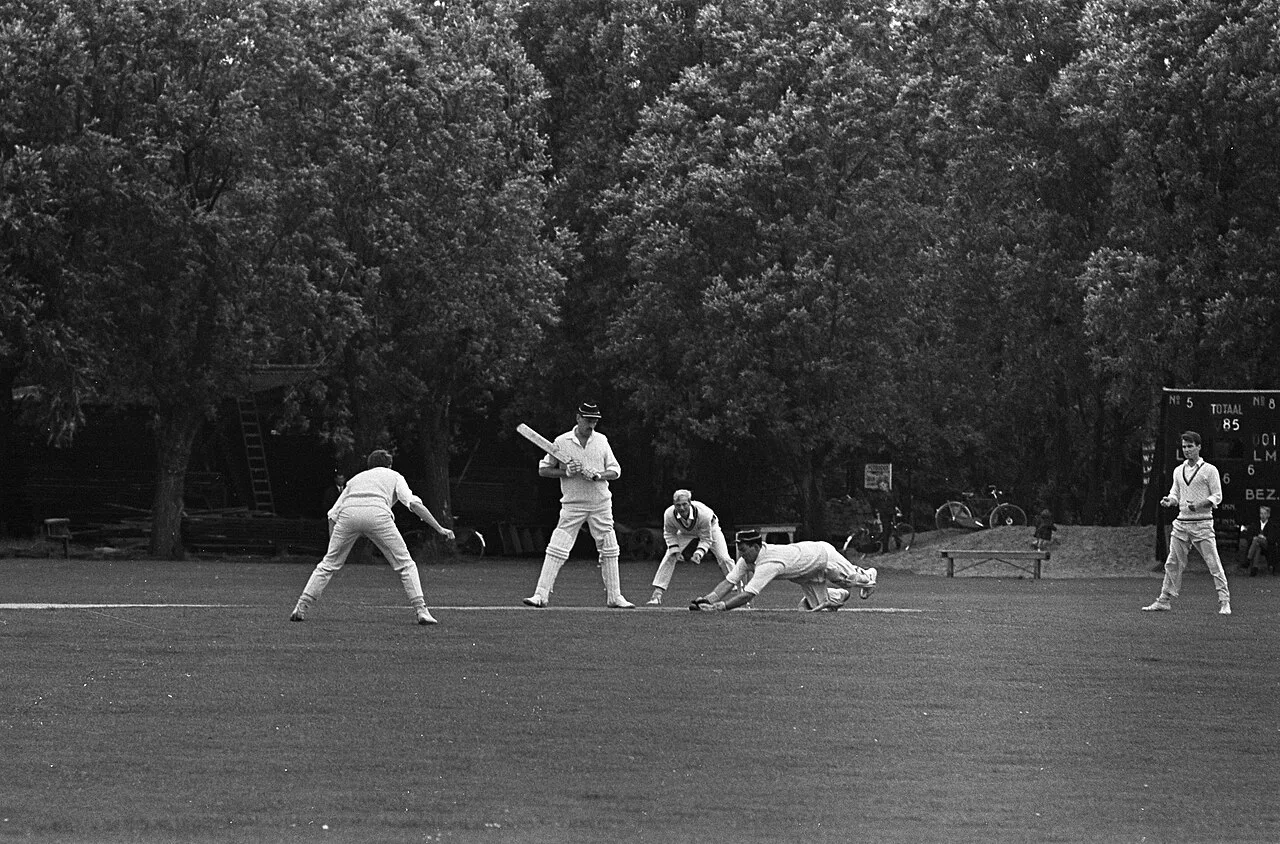
An HCC–ACC keeping sequence from 11 July 1965 illustrates reach and recovery movement; the keeper is not Tim Seifert.
Connect runs and balls faced with batting position, field, target and wickets in hand. Strike rate measures scoring speed, but it does not describe every opportunity or risk. A useful assessment explains how Seifert's choices changed the team's position during the innings.
Opening against a new ball creates a different task from entering late in a run chase. In a powerplay, the available field protection differs from later phases under the applicable conditions. An attacking shot may seek to exploit that temporary opportunity, but its success still depends on selecting a suitable ball.
Suppose a hypothetical innings begins with 18 from twelve deliveries. The strike rate is 150. That number could reflect controlled scoring from several areas or two boundaries and a long sequence of dots. The scoring pattern tells you more about pressure and continuity.
Track dot balls and strike rotation as well as boundary shots. A batter who keeps finding singles may help a partner avoid becoming stuck. Another who relies heavily on boundaries can create a different rhythm, which may be productive or risky depending on the target.
Running between wickets belongs in the assessment. Watch the first call, backing up and the decision on a second run. A successful two after a well-fielded shot can be an important contribution even though no boundary appears in the highlights.
When are attacking shots sensible rather than careless?
An attacking shot is sensible when its expected benefit fits the delivery, field and scoring demand. Aggression is a decision about risk, not an automatic virtue or mistake. Judge the choice at the time it was made, then discuss whether the execution matched that choice.
A sweep, ramp or pull can target an available gap, but each responds to a different delivery and field arrangement. Naming a creative stroke does not explain why it was attempted. Note where the ball pitched, the batter's position and the protected areas.
In a hypothetical chase requiring 36 from eighteen balls, the team needs twelve per over. Taking some additional risk may be necessary. The same shot at a comfortable scoring rate with several overs remaining could raise a different tactical question.
Distinguish the plan from the result. A well-chosen stroke can find a fielder, while a mistimed attempt can land safely. If every successful attack becomes “intent” and every dismissal becomes “recklessness,” the analysis is only renaming outcomes.
Look at preceding deliveries. Several dots may have increased pressure, a bowler may have changed pace, or the field may have shifted. Those details can explain why an otherwise unusual option became attractive. They are usually missing from a clip that starts immediately before the dismissal.
Compare available alternatives
Choose one important attacking shot and identify two other plausible scoring options. Explain what each would risk and protect. This exercise turns a vague criticism into a concrete discussion of choices.
How do you compare keeping and batting without collapsing them into one score?
Assess each discipline on its own evidence, then describe how the two contributions affected the team. Batting runs, keeping dismissals and routine collections measure different things. Adding them into an improvised “overall score” can conceal more than it explains, especially when opportunities vary between matches.
Build two panels in your notes. For wicketkeeping, record starting position, movement, clean takes, chances and visible communication. For batting, record entry situation, runs, balls, scoring phases and dismissal. Use a separate line for any relationship you can genuinely observe.
A long period behind the stumps may create a substantial workload, but avoid diagnosing fatigue from one mistimed shot. The visible fact might be a difficult collection sequence or a short break before batting. An explanation involving physical condition needs stronger evidence.
Similarly, a quiet keeping match can mean few chances rather than poor involvement. If batters do not edge the ball, a keeper cannot manufacture catches simply to improve a total. Opportunity must remain attached to any comparison.
Do not combine international, domestic and franchise figures without explaining the categories. T20I records are not the same as all T20 records, and a tournament role may differ from a national-team role. Use the match identity to establish which responsibility Seifert actually carried.
What is a practical observation exercise for a cricket student?
Study one complete over of wicketkeeping and one complete batting passage, using the same worksheet each time. Record visible actions before writing an interpretation. This creates a small but inspectable sample and helps distinguish repeatable technique from the exceptional moments selected for highlight packages.
For the keeping over, make six legal-ball rows and add any extra deliveries. Record the side of the take, movement, collection height and outcome. Mark a leg side take separately from an off side take so you can compare different movement demands.
For the batting passage, record the field before the first ball, then note delivery type, shot selection and result. Calculate the passage's scoring rate only after the sequence is complete. That prevents an early boundary from dominating your impression of an otherwise difficult over.
Ask a partner to observe the same footage without seeing your notes. Compare points of agreement first, then revisit disputed actions. If the view cannot settle a disagreement, retain the uncertainty. There is no benefit in giving an exact label to an action that remains unclear.
Turn notes into an evidence-based paragraph
Open with the verified fixture and Seifert's actual role. Explain one keeping adjustment and one batting decision using the sequence you observed. Finish with a conclusion limited to those passages. Do not turn a six-ball exercise into a judgement about a full career.
An effective paragraph should allow another reader to locate the evidence and understand the reasoning. Replace vague praise such as “great energy” with the specific action: moving early into line, receiving a difficult throw cleanly or rotating after consecutive dot balls.
Keep the worksheet for later matches. As the sample size grows, compare similar tasks rather than simply adding every highlight together. A repeated strength becomes more convincing when it appears across comparable situations, and an apparent weakness may disappear once you understand the different demands.
This approach makes Seifert's less visible work part of the discussion. It recognises that a keeper's best movement can make a difficult task look ordinary, and that a batter's useful decision may produce a single rather than a memorable stroke. Both deserve careful observation.
An additional useful sequence is the return from the boundary. Follow the fielders as well as the keeper: identify who gathers, where the throw travels and how the receiving player positions the gloves. Record whether the take permits an immediate attempt at the stumps or requires recovery. This broadens the exercise beyond the final image of broken bails. It also shows how a wicketkeeping action depends on the accuracy and timing of the wider fielding unit. A complete description can praise both contributions without inventing separate numerical shares of the dismissal.
Compare the batting section with the middle-order innings guide to see how entry situations change the task. For keeping to a spinner, the Santner spin analysis provides useful delivery context. The ODI scorecard guide then explains how catches, stumpings and extras enter the record, helping you connect observation with the statistical panel.
Sources
Image credits: Cover: Unknown author, source, Public domain. Resized and converted to WebP. Article image: Eric Koch for Anefo, source, CC0. Resized and converted to WebP.
Found an error or an outdated detail? Report a correction with the article URL and original source.