
Lahore High Court: Finding Cases and Reading Orders
Learn to use Lahore High Court’s official case information, distinguish a hearing from a judgment, and read legal news without assuming the outcome.

Lahore High Court case information becomes easier to understand when you separate a scheduled hearing, a procedural update and a written decision. Start with the correct case identity, then read what the relevant document actually records. A cause list is not a judgment, and a headline quoting an argument does not establish that the court accepted it.
This is a public-record reading guide for students and general readers, rather than instructions for conducting litigation. The court's official website and its published materials are the starting points. Live availability can vary, so the examples below are hypothetical and do not claim that a particular case was heard, decided or updated today.
What information identifies a Lahore High Court case?
Use the case type, number, year, parties and relevant court location together. Names alone can produce ambiguous results, especially when an organisation appears in several proceedings. Confirm the document header before summarising the case, and avoid assuming that a search result concerning the same person necessarily concerns the same legal matter.
Imagine two fictional petitions involving the same college, filed in different years about different issues. A search for the college name could show both. If you combine a hearing date from one with an order from the other, the resulting summary can sound coherent while being wrong. The number and year provide a much more reliable connection.
Record the bench or judge as the document identifies them, without inferring that every later hearing will have the same assignment. Case information is tied to particular dates and records. A useful notebook preserves the document date and the date you accessed it. This makes a later correction possible if a listing changes or a newer order appears.
Keep personal information proportionate to the task. An educational summary rarely needs identification numbers, private addresses or family contact details. Even where a public document contains them, copying everything can create unnecessary exposure. Identify the matter accurately using its public case reference and the minimum relevant party description, especially when discussing vulnerable people or sensitive allegations.
What does a cause list tell you?
A cause list concerns matters scheduled before a court or bench on a stated date. It is useful for identifying a planned listing, but it does not by itself establish that a hearing occurred, that arguments were completed or that a particular outcome followed. Look for the later record before describing what happened.
Read the date, court location and list category carefully. A saved PDF can remain on a phone long after the relevant day. Sharing it without its header removes the context that makes it useful. If a screenshot only shows a party name and serial number, recover the full page before drawing conclusions about when or where it applies.
Do not convert a list position into a promised hearing time. The document's own wording controls what it establishes. Court schedules can change, and a reader should not make travel or legal decisions from an educational article's interpretation. People involved in an actual case should confirm arrangements through their lawyer and the current official process.
For a civics exercise, compare a hypothetical listing with a later order. Write one sentence about the scheduled event and another about the recorded outcome. If you have only the listing, leave the outcome unknown. This practice develops accuracy by showing how a document can be authoritative for one question while remaining insufficient for another.
How do case status, an interim order and a judgment differ?
A case status entry summarises procedural information. An interim order gives directions or relief at an intermediate stage, while a judgment usually contains a fuller decision and reasoning on the matters addressed. Read the exact document because labels alone cannot establish its full legal effect, duration or relationship to later proceedings.
Suppose an invented order asks an authority to provide a response before the next hearing. That direction does not establish that the applicant has won the entire dispute. A news summary saying “court seeks response” should retain that limited meaning. Expanding it into “court confirms wrongdoing” would replace a procedural step with an unsupported conclusion.
Likewise, an interim stay must be understood through its wording, scope and any conditions. A reader should not assume that it applies to every related person or lasts indefinitely. If a later order modifies the arrangement, an earlier screenshot can mislead. Follow the document sequence instead of treating the most widely shared page as the final position.
Words such as disposed, dismissed and allowed need context. Their practical effect depends on what was before the court and what the operative directions say. For an actual dispute, qualified legal advice is necessary to understand obligations and deadlines. This guide helps readers recognise why the document matters; it does not determine what an individual should file or do next.
How should you read the reasoning and operative part?
Read the background, issues, parties' arguments, reasoning and final directions as separate components. A judgment can reproduce a submission without adopting it. The operative part identifies what the court directs or decides, but it should be understood with the reasoning and any limitations stated elsewhere in the document.
A practical method uses three colours in a private study copy. Mark the applicant's request, the opposing position and the court's own conclusion differently. If colours are unavailable, label the margins. This prevents a quoted accusation or an argument about the law from slipping into your summary as though it were an established judicial finding.
Pay attention to verbs. “Submitted,” “contended” and “argued” often identify a party's position. “Directed” and “held” may introduce the court's conclusions, but the surrounding text still matters. Do not build a summary by searching for one dramatic sentence. Read enough of the document to identify who is speaking and what question the sentence answers.
When preparing a student case brief, write the issue as a question, then state the answer supported by the document. Add the reason and the exact procedural result. If the court leaves an issue open, say so. A short accurate brief is better than a comprehensive-sounding narrative that resolves questions the court did not decide.
How can legal news distort an otherwise accurate quotation?
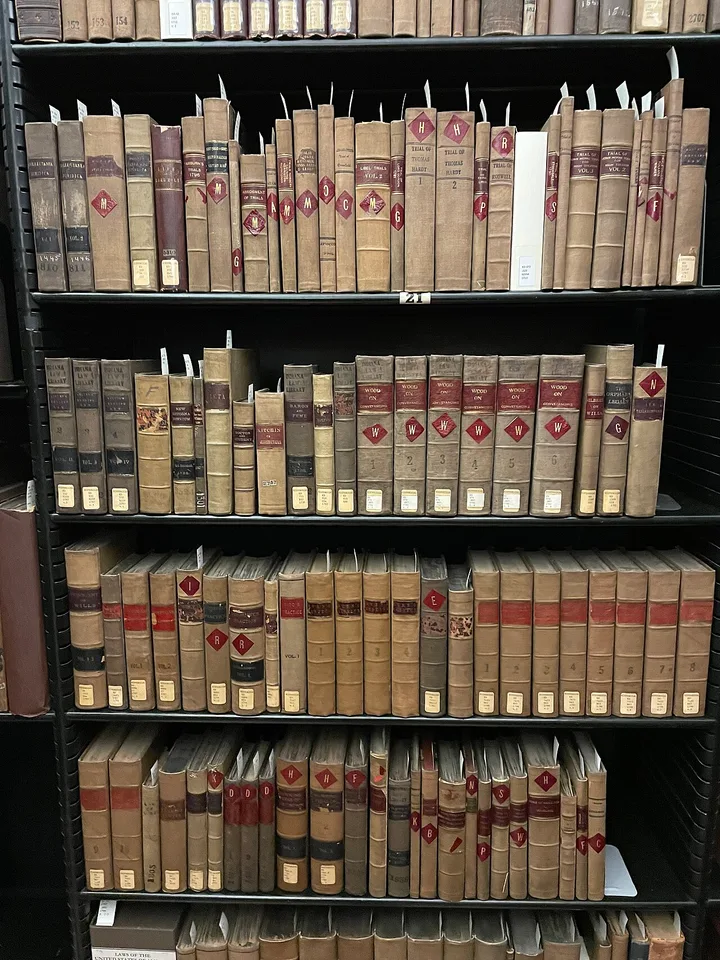
A US law-library shelf photographed in 2023 illustrates legal reference material, not a Lahore case file or Pakistani legal authority.
A quotation can be word-for-word accurate yet misleading when its speaker, procedural setting or surrounding qualification is omitted. Check whether the words come from a party, counsel or the court. Then ask whether they describe an allegation, a question, an observation or a binding direction in the written record.
Consider a hypothetical headline saying a public body was “ordered to explain.” That might accurately describe a request for a response. It would not establish that the response was unsatisfactory or that liability was determined. A good news-reading habit keeps the headline's verb and compares it with the actual direction rather than filling in a dramatic ending.
Short video clips introduce another problem: an oral exchange can circulate before a written order is available. A question asked during argument may test a proposition rather than announce a conclusion. For a careful summary, distinguish a reported hearing exchange from the published document. Do not claim that your interpretation settles a dispute between the two.
Compare this practice with the public-record news guide, which separates statements from institutional action. In both settings, the crucial task is identifying what the evidence actually establishes. Several accounts repeating the same sentence do not create several independent confirmations if all of them rely on one incomplete report.
How should you organise documents from several hearings?
Build a dated chronology using the case reference as the anchor. For each document, record the date, document type, direction and next stated step. Keep earlier entries instead of overwriting them. A chronology shows how the procedural position changes while reducing the risk that an old order will be presented as current.
Use file names that remain understandable outside the browser, such as date, case reference and document type. Keep the original PDF alongside any private notes. A downloaded file called “final-new” is difficult to verify later. Clear naming helps a student explain where an interpretation came from without altering the source document itself.
Separate missing records from negative findings. If you cannot locate a later order, write that you have not located it. Do not state that no order exists or that nothing happened. Public search limitations, publication delays and incomplete indexing can all affect what you find. The claim should describe your evidence rather than pretend to describe every possible record.
The provincial public-record guide uses a similar chronology for announcements and implementation documents. The institutions differ, but the method transfers well: label the record, preserve its date and state the action it records. That makes a developing story easier to update without rewriting earlier uncertainty as though it had always been resolved.
What privacy and fairness checks belong in a case summary?
Include only personal details needed to explain the issue, and distinguish allegations from findings throughout the summary. The existence of proceedings does not establish guilt or liability. Check the document's own restrictions and seek appropriate guidance where publication is sensitive, rather than assuming that public availability makes every detail suitable for republication.
Avoid copying identity documents, signatures, ticket-like barcodes, private phone numbers or unrelated family information into class presentations. These rarely improve the legal explanation. A redacted study note can preserve the issue and direction while reducing unnecessary exposure. Do not alter the original source in a way that conceals its wording or misrepresents the official document.
Fairness also concerns grammar. Write that a party alleged a particular action when that is what the record says. Avoid dropping the attribution in the next paragraph and treating the allegation as fact. If the court rejects or leaves the issue unresolved, keep that result visible. Precision should continue beyond the opening caveat and shape the whole account.
For a classroom discussion, ask students to identify the minimum facts necessary to understand a hypothetical dispute. This can be paired with the fiction and evidence guide to examine how narrative expectations affect judgement. Real legal records should be read with care precisely because they concern actual rights, responsibilities and people rather than a scripted resolution.
How can students write a useful court-reading exercise?
Choose one accessible published document and answer four questions: what was requested, what issue was addressed, what did the court direct and what remains unresolved? Keep the case identity and document date attached. The purpose is an accurate reading exercise, not advice about bringing a similar case or predicting another court's decision.
Start by writing a neutral background in two sentences. Then quote only a short phrase if exact language is necessary; paraphrase the rest carefully. Identify the operative direction and compare it with the relief requested. This shows whether the document addresses the whole request, only part of it or a procedural step before the main issue can be considered.
Next, write a limitation specific to the material. You might have one order but not the pleadings, or an earlier judgment without later proceedings. The limitation should explain how the missing material affects the conclusion. Avoid a generic disclaimer that leaves an overconfident summary untouched. The narrower claim should appear in the main paragraph itself.
Finally, exchange summaries with a classmate and ask them to underline any statement the document does not support. If they cannot trace a sentence to the record, revise it. The exercise builds source literacy, neutral writing and attention to chronology. Those skills remain useful in public affairs even when the reader never needs to participate in litigation personally.
A document comparison
| Material | Useful for | Insufficient by itself for |
|---|---|---|
| Cause list | Planned listing | Hearing outcome |
| Case status | Procedural snapshot | Full reasoning |
| Interim order | Stated temporary directions | Final resolution of every issue |
| Judgment | Reasons and decision addressed | Later appellate position |
| News clip | Reported exchange | Complete written order |
Before sharing a summary, check that it would still make sense if read a month later. Add dates where “today” or “next hearing” would become unclear. Replace a vague claim that the court “gave a big decision” with the actual action recorded. This final edit makes the article useful to readers who arrive after the immediate news cycle has passed.
Practise a neutral rewrite
Take the invented sentence “the court exposed the agency after a hearing” and ask which document would support each part. If the order merely requests a response, rewrite it to say that the agency was directed to respond on the stated issue. Remove the word exposed because it adds a conclusion not established by the hypothetical order.
Then check the next sentence for the same problem. Writers sometimes attribute an allegation correctly at first and repeat it later without attribution. A complete edit preserves the distinction throughout the paragraph. The exercise is especially useful when a headline must be short, because precise verbs can communicate the actual development without borrowing certainty from dramatic language.
Sources
Image credits: Cover: MariyamAftab, source, CC BY-SA 4.0. Resized and converted to WebP. Article image: Dominic, source, CC0. Resized and converted to WebP.
Found an error or an outdated detail? Report a correction with the article URL and original source.