
NFL for Beginners: Downs, Scoring and the Clock
Learn the basics of NFL football, including downs, possession, touchdowns and the game clock, with official rules and a simple worked example.
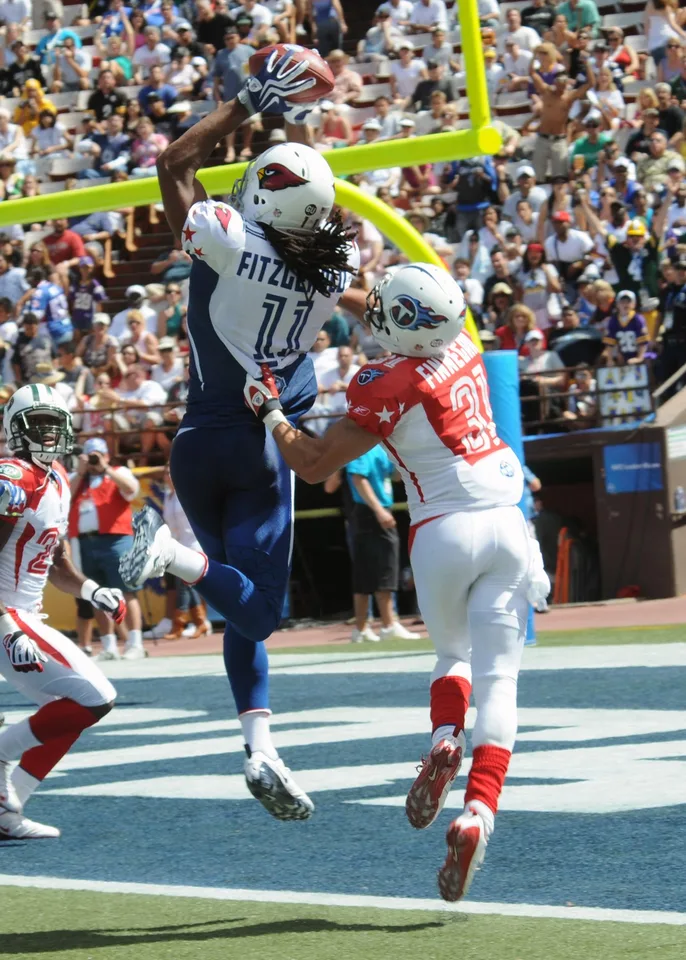
The easiest way to follow NFL football is to track possession, down and distance, field position and the clock. The offence tries to move the ball toward its opponent's end zone, while the defence tries to stop it or take possession. Scoring matters, but those four pieces of context explain the decisions between scores.
This beginner's guide covers NFL American football rather than association football or a different gridiron rule system. It uses invented plays and scores to teach viewing skills. Start with one drive, the sequence of plays during a possession, and add formations and specialist terminology only after the basic progress of that drive makes sense.
What does first-and-ten mean?
First-and-ten means the offence is on its first down with ten yards needed to reach the next first down. A down is an opportunity to run a play. The offence normally has four downs to gain the required distance, although penalties and special situations can alter the sequence.
Imagine the offence begins at its own 25-yard line and gains six yards. In a straightforward example without a penalty, the next situation is second-and-four at the 31. If the following play gains another five, the offence has passed the original line to gain and receives a new first down at the new spot.
The distance is not always ten yards. A lost-yardage play can make the next attempt longer, while a successful gain can shorten it. Near the goal line, the broadcast may show first-and-goal because the scoring line replaces an ordinary ten-yard target. Read the graphic each time rather than assuming every first down has identical geometry.
For your first viewing, write the starting situation and the next situation after each play. The exercise makes progress visible even when no one scores. Once you can explain why a four-yard gain helps on third-and-three but falls short on third-and-six, you understand a central part of the sport's tactical language.
Why do teams punt instead of using every fourth down?
A punt exchanges possession for an attempt to improve field position. A team facing fourth down may judge that failing to gain the required distance would give its opponent too favourable a starting point. Punting is therefore a strategic choice about risk and territory, not simply an admission that the offence has stopped trying.
Consider two invented situations: fourth-and-eight deep in a team's own half, and fourth-and-one near the opponent's end zone. The distance, location and possible reward differ. A team can reasonably make different choices in those situations without changing its overall willingness to take risks. Score and remaining time add further considerations.
A turnover on downs occurs when the offence fails to retain possession through the required progress under the rules. It differs from a punt because the latter is an intentional kick with its own outcome and field-position consequences. An interception and a lost fumble are other ways possession can change, each arising through a different event.
Do not judge the decision solely from whether it worked. A risky fourth-down attempt can succeed without having been the best option, and a well-reasoned attempt can fail. Ask what the team knew beforehand: distance, available players, score, time and the consequences of handing the ball over at that location.
How do touchdowns, field goals and tries change the score?
A touchdown is worth six points, while a field goal is worth three. After a touchdown, the scoring team has a try that can add one point through the usual kick option or two through a successful two-point conversion. A safety normally awards two points to the opposing team under the applicable conditions.
Keep the touchdown and try separate in your notebook. If a team scores a touchdown from zero, it first reaches six. A successful extra point makes seven, while a successful two-point conversion makes eight. A missed try leaves six. This prevents the common beginner's shortcut of assuming a touchdown automatically means seven points.
Use score differences to understand decisions. In an invented game, a side trailing by eight can potentially draw level with a touchdown and a successful two-point conversion. A side trailing by three may be able to tie with a field goal. Those arithmetic possibilities explain urgency without guaranteeing that the necessary plays will succeed.
Scoring can include unusual situations, so use the official rulebook for a disputed sequence. The practical beginner's task is to identify what was awarded, then update the difference between the teams. Avoid importing scoring assumptions from rugby, college football or another competition merely because the ball and field markings look familiar.
| Scoring event | Ordinary points | Viewing reminder |
|---|---|---|
| Touchdown | Six | The following try is separate |
| Field goal | Three | Field position affects the decision |
| Extra-point kick | One | It must succeed |
| Two-point conversion | Two | It follows a touchdown |
| Safety | Two | Special possession and scoring conditions apply |
Why are the game clock and play clock different?
The game clock measures time within the contest, while the play clock limits the time available to begin the next play. They serve different purposes and can show different states. A stopped game clock does not mean the offence can wait indefinitely before the next snap once the relevant play-clock process is running.
NFL regulation consists of four fifteen-minute quarters, but sixty minutes of game time does not mean a sixty-minute broadcast. Stoppages, intervals, reviews and other events extend real viewing time. When arranging a first viewing, allow for the distinction instead of assuming the programme will end an hour after the opening kick.
Clock behaviour depends on the event and the situation. An incomplete pass, an out-of-bounds finish and a running play can lead to different timing consequences. Some restart rules also depend on when the play occurs. For a disputed example, identify the exact event and remaining time rather than applying one remembered rule to every stoppage.
To practise, record whether the game clock is moving before and after five consecutive plays. Add a short description of each outcome. Then compare the pattern with the rulebook explanation. The exercise builds a more accurate understanding than memorising a slogan such as “leaving the field always stops time until the next snap.”
How should a beginner recognise the main player roles?
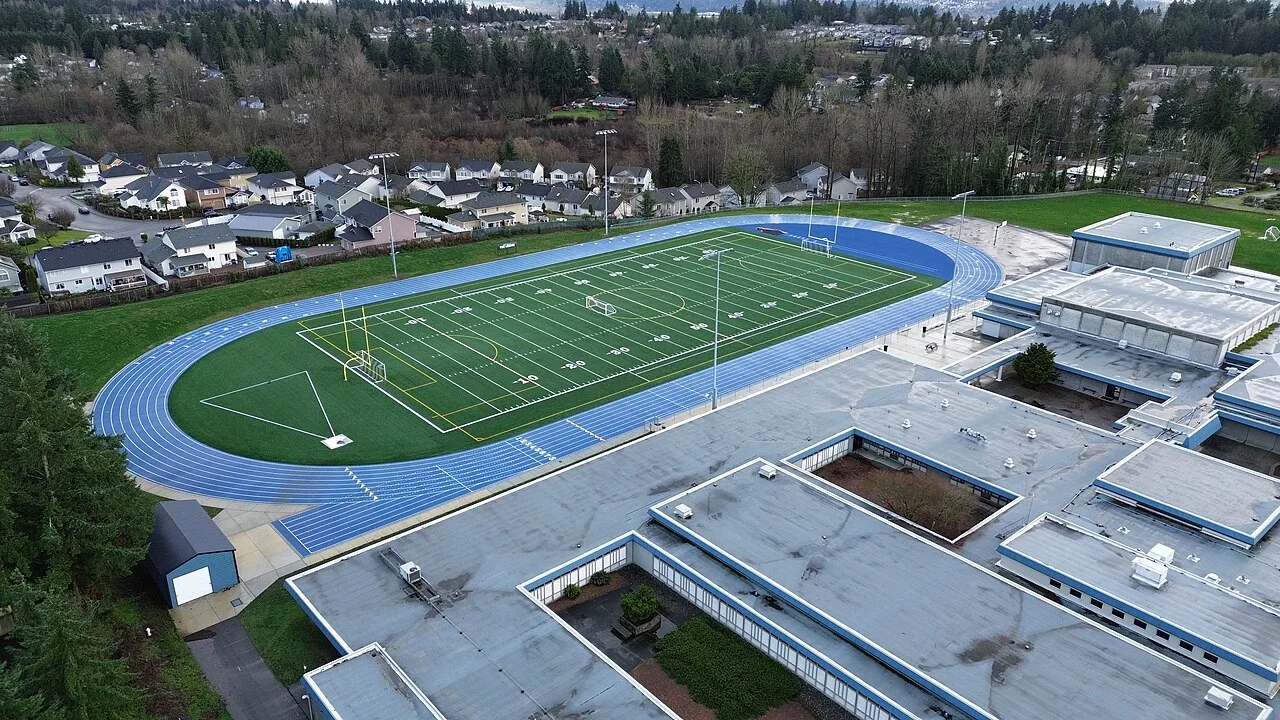
A school football field in Kent, Washington, photographed in 2026; use the field layout for orientation, not as an NFL venue.
Begin with the quarterback, the offensive line, eligible receiving options and the defenders trying to disrupt them. The quarterback often coordinates the play and may hand off, pass or run. Other roles become easier to understand when connected to what they do on a specific play instead of memorised as a disconnected list.
Watch the snap first. It starts the action from the line of scrimmage, and the ball's initial movement helps identify the developing play. On a run, follow the ball carrier and the available space. On a pass, observe protection, the intended receiver and the defender's position. Camera framing may prevent you from seeing every route.
A running back, wide receiver and tight end can contribute in different ways depending on the formation and assignment. The same player may block on one play and become a receiving option on another. Avoid treating a position label as proof of one fixed action throughout the game. The actual play supplies the useful evidence.
On defence, begin by noticing pressure near the quarterback and coverage farther downfield. You do not need to identify every defensive package immediately. Choose one question, such as whether extra pressure leaves space for a quick pass. This turns unfamiliar terminology into a visible relationship between choices and opportunities.
What do penalties and replay reviews mean for the result of a play?
A penalty can alter yardage, down, possession or other consequences according to the offence and enforcement rules. A replay process can examine eligible decisions under the current regulations. When a flag or review appears, wait for the official ruling before treating the apparent gain, score or turnover as the final play outcome.
For an invented example, a long gain followed by an accepted offensive penalty may leave the next situation very different from the one suggested by the initial action. The television replay of the exciting catch is not the whole result. Listen to the referee's explanation and read the updated down-and-distance graphic.
Distinguish the foul being discussed from the penalty actually enforced. A commentator's immediate interpretation can be provisional, and an opposing team may have choices under the rules. Your notes should record the announced enforcement and resulting situation rather than preserving the first speculative description as if it were official.
The same principle applies to a potential touchdown reviewed near a boundary. Record the initial signal, the review and the final ruling as separate events. You can analyse why the play was close without inventing a rule from one camera angle. A careful beginner learns to follow the adjudication sequence as well as the athletic action.
How does the score change a team's clock strategy?
A team protecting a lead often values possession and the passage of time, while a trailing team may value speed and additional chances to score. The exact choice depends on timeouts, field position, down and distance. A play's value therefore includes what it does to the clock as well as the yards gained.
Imagine a team leading by a small margin late in regulation. A short gain that keeps the clock moving may be useful even if it produces no highlight. Now reverse the score: the same short gain might consume time the offence urgently needs. Identical yardage can have different strategic value because the task has changed.
Timeouts are part of that resource calculation. Count those remaining for both sides rather than noting only the clock. A defence able to stop time can preserve more opportunity for a later possession. An offence with timeouts may have different choices about where to send a pass. The details need the actual game situation.
For a useful comparison with another sport, the cricket match-day checklist tracks runs, wickets and balls remaining. The variables differ, but both exercises teach resource-based reasoning: understand what the team must achieve, what opportunities remain and which decision trades one resource for another.
How can you follow your first full drive without getting overwhelmed?
Follow one possession using four fields: starting location, down and distance, time and outcome. Ignore unfamiliar formation names at first. After each play, update those fields and explain whether the offence improved its position. This gives the drive a coherent story before you add detailed statistics or individual performance judgments.
Use an invented sequence for practice: first-and-ten, a six-yard gain, a two-yard gain and then a three-yard gain. Explain why the third play produces a new first down in that simplified example. Next, change the second play into a loss and calculate the new situation. Small changes reveal why down and distance must be updated continuously.
When the drive ends, classify its outcome: touchdown, field-goal attempt, punt, turnover or another official result. Then write two sentences about the most consequential decision. Avoid claiming that a single missed play explains the entire match. A full contest contains many possessions and different starting conditions.
The Everton vs Newcastle match-reading guide offers a contrasting exercise in association football, where possession and territory operate through different rules. The tennis match-analysis guide provides another useful comparison of scoring units. Use these contrasts to clarify definitions, not to assume the sports share a rule system.
Build a five-play learning routine
Watch five consecutive plays and pause your note-taking after each one. Describe only the starting situation, the action you could see and the confirmed result. On a second viewing, add one tactical observation, such as protection holding long enough for a pass or a defender closing the running lane. Keep interpretation tied to the actual footage.
After the sequence, explain the drive to someone who has not watched it. If your account requires unexplained terms, replace them with plain descriptions before adding the technical label. This is a useful test of understanding: being able to say what the offence needed, what changed and why the next decision differed from the previous one.
As confidence grows, add a single new topic per viewing. One week focus on third downs; another, watch red-zone decisions; another, compare late-game clock choices. Trying to learn every rule from one broadcast usually produces a glossary without understanding. Repeated observation of a small, defined question turns the sport into a sequence of intelligible decisions.
Keep the current season's rules as the reference for unusual cases and overtime. A familiar highlight from an older year may operate under different conditions. For ordinary viewing, the central habit remains stable: establish possession, read the situation and wait for the confirmed outcome before explaining why a play mattered.
A simple self-check is to explain the difference between gaining ten yards during one play and gaining ten yards across several plays. Both can earn a new first down when the relevant line is reached. What matters is progress from the starting requirement within the available downs, with penalties and the official spot accounted for. That explanation captures the sport's basic rhythm better than a collection of spectacular scoring clips.
Sources
Image credits: Cover: Mass Communication Specialist 2nd Class Michael A. Lantron, USN, source, Public domain. Resized and converted to WebP. Article image: Roc0ast3r, source, CC0. Resized and converted to WebP.
Found an error or an outdated detail? Report a correction with the article URL and original source.