
Sonny Baker: Fast Bowling Beyond the Speed Figure
Study Sonny Baker through pace, control and match context, and learn to check official player records before interpreting bowling performances.

Sonny Baker is identified by Hampshire's official squad profile as a right-arm fast bowler. That gives readers a verified starting point, but a useful bowling analysis requires more than the fastest delivery shown on television. Pace matters alongside line, length, movement, field placement and the situation in which the spell is bowled.
This guide focuses on watching fast bowling and interpreting a scorecard. It does not assign Baker an unverified current speed record, selection status or injury diagnosis. The numbered examples are hypothetical practice sequences. Use them to build a method, then apply that method to a complete, correctly identified match record or authorised footage.
What can one speed reading tell you about Sonny Baker?
A speed reading describes one measured delivery under the broadcast's conditions. It cannot establish average pace across a spell or a career. Record the ball, match and measurement unit before comparing it with another reading, then ask whether pace contributed to the batter's difficulty or merely created an eye-catching television graphic.
Imagine one delivery recorded at a high speed but far outside the batter's useful hitting area. Another, slightly slower ball threatens the stumps. The first may impress viewers while the second creates the stronger immediate challenge. The example shows why speed and effectiveness should be connected through the delivery's location and the batter's response.
Keep kilometres per hour and miles per hour distinct. A comparison should use the same unit and a clearly identified sample. Maximum speed, mean speed and variation through a spell answer different questions. If only selected readings are available, describe those readings rather than inventing an average from deliveries that were not shown or measured publicly.
Watch the consequences of pace: hurried footwork, a late defensive movement or a mistimed shot can be relevant observations. They still need context. A batter can react late because of length, uncertainty or movement as well as speed. A careful paragraph describes the visible response and offers a proportionate explanation rather than attributing every uncomfortable moment to raw velocity.
How should line and length be recorded?
Line describes the ball's lateral path relative to the batter and stumps, while length describes where it pitches. Together they help explain the available shot options. Record them ball by ball using consistent categories, and distinguish the observed delivery from any guess about the bowler's intended target or tactical plan.
A simple observation sheet can use fuller, good and shorter length, with line described relative to the stumps. These categories are approximate viewing tools rather than exact tracking measurements. Camera perspective can distort distance. If a replay is unclear, write uncertain instead of pretending that every ball can be located precisely from the broadcast angle.
Consider a hypothetical sequence of three balls outside off stump followed by one straighter delivery. The sequence may be consistent with drawing the batter across, but intention is not directly visible. Look for supporting evidence such as field placement, repeated patterns or commentary from the bowler. Describe the sequence confidently while keeping the inferred plan appropriately tentative.
The spin-bowling performance guide uses a different skill set but the same observation principle. Record where the ball goes, how the batter responds and what happens next. This prevents outcome-driven analysis in which a boundary is automatically called a bad ball and a wicket automatically proves that every preceding decision was perfect.
What is the difference between swing, seam and bounce?
Swing concerns movement through the air, seam movement concerns deviation associated with the ball pitching, and bounce concerns its vertical response after pitching. Broadcast footage may not show enough detail to distinguish them confidently. Describe the visible path first and use technical labels only when the available view supports them.
For a useful replay exercise, watch from release to pitching, then from pitching to the batter. If movement appears before the bounce, that supports a different description from a sudden change after it. Perspective and camera movement can still mislead. A single end-on view may suggest lateral movement without precisely identifying how much occurred or why.
Do not call every difficult delivery a swinging ball. Extra bounce, a change of angle or an awkward length can also produce an edge or a miss. Likewise, a ball passing close to the bat does not prove that it moved substantially. The batter's initial alignment and shot choice can contribute to the gap that viewers notice.
Conditions belong in the notebook when documented. The ball's age, surface and weather can be relevant, but avoid inventing their effects from a cloudy sky shown briefly on screen. A match report may identify conditions more reliably than a highlight montage. State what is known, then explain the observed delivery rather than using conditions as an automatic explanation for every result.
How do field placement and bowling angle reveal a plan?
Field placement and bowling angle can suggest which outcomes a team is trying to encourage or prevent. Observe them together with repeated deliveries. A catching position, boundary rider or change from over the wicket to round the wicket provides context, but no single field setting proves the bowler's entire intention.
Imagine a short-ball sequence with a fielder placed for a particular aerial shot. If the batter attempts that shot and a chance results, the field and length support a coherent explanation. If the broadcast never shows the field, avoid inventing it after the wicket. A tactical claim needs visible or documented evidence, not simply a satisfying story.
Compare the same delivery against different fields. A fuller ball outside off stump may create one risk with close catchers and another with boundary protection. The field does not change the ball already delivered, but it changes the possible reward and cost of the batter's response. This helps explain why a bowler's role cannot be understood in isolation.
The spin and captaincy guide offers a related way to connect personnel, field and match situation. For Baker, keep the focus on fast-bowling evidence rather than copying a spin explanation. Different methods can share the same analytical discipline while relying on different release mechanics, trajectories and tactical options.
How do you read overs, economy rate and wickets correctly?
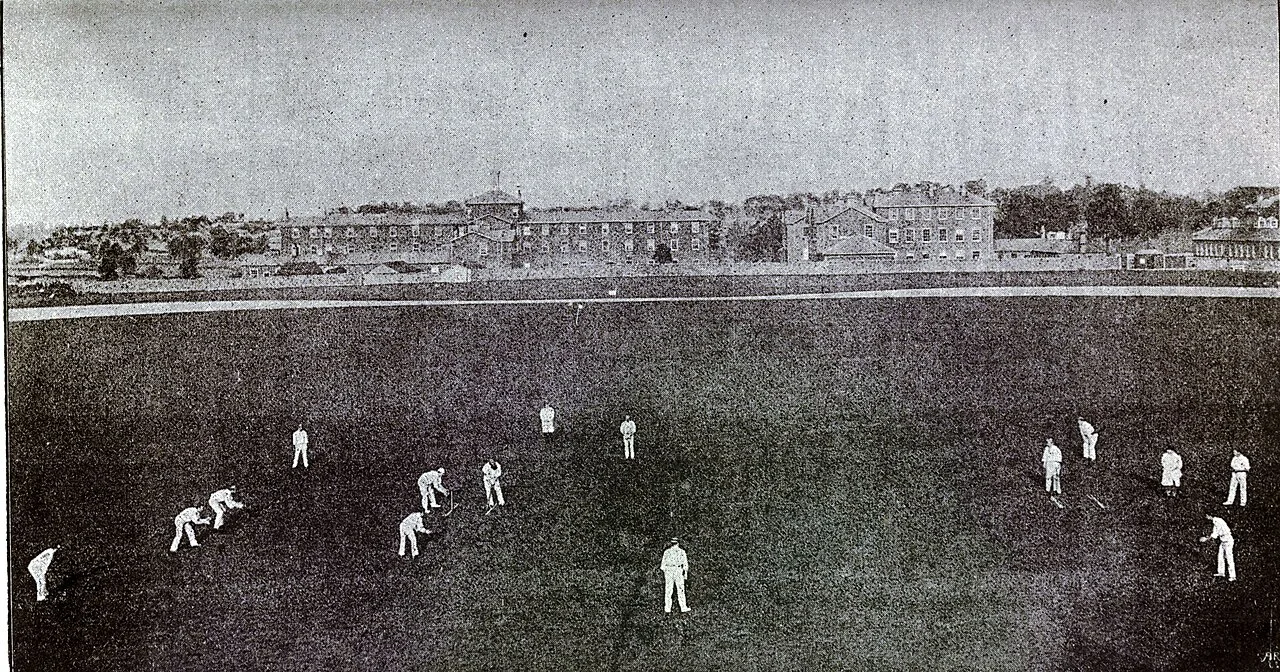
An 1891 field-placement diagram supports discussion of line, field and bowling plans; it is historical, not Baker’s match field.
Bowling figures record outcomes, while economy rate expresses runs conceded per over on the relevant basis. Convert partial overs into legal balls before calculating. Wickets need dismissal context because not every team wicket is credited to the bowler. Read the scorecard and applicable competition conditions rather than treating all formats as statistically interchangeable.
In a standard six-ball-over example, 3.2 overs means twenty legal deliveries, not three point two decimal overs. If a bowler concedes twenty runs in those twenty balls, the economy rate is six runs per six legal balls. The calculation is twenty multiplied by six and divided by twenty. This is an invented example, not a Baker match return.
Wides and no-balls affect the record differently from legal deliveries. Byes and leg byes are team extras with their own scoring treatment. Rather than reconstructing a full scorecard from highlights, use the completed record and scoring guidance. A clip may omit an extra or show a wicket without enough information to identify how the dismissal is officially recorded.
Bowling average and bowling strike rate also describe different relationships. Average connects runs conceded with wickets; strike rate connects balls with wickets. A small sample can move sharply after one dismissal. The cricket scorecard guide provides related reading practice, but the particular match and format should remain visible in your own calculation.
Why does match phase change the judgement of a spell?
A new-ball spell, middle-overs spell and closing spell can involve different fields, batter intentions and scoring risks. Judge the performance against the actual task. Runs conceded, wickets and dot balls become more informative when you know the format, innings stage, target and partnership rather than comparing every spell against one universal standard.
In a hypothetical limited-overs game, a batter chasing a demanding target may attack deliveries that would be left alone in a longer match. That changes the chances and boundary risk faced by the bowler. A higher economy rate can still require criticism, but the explanation should consider the situation rather than treating the number as self-explanatory.
In first-class cricket, a bowler may create pressure with repeated challenging deliveries without taking the wicket in that spell. Record the pressure through observable events, such as defensive responses and scoring restrictions. Do not invent an exact value for “pressure wickets” elsewhere unless a defined dataset actually measures the relationship. Qualitative contribution and credited wickets should remain separate.
Comparisons work best within a defined role and competition. Choose several opening spells or several closing spells instead of mixing unrelated opportunities. Record opposition and conditions where documented. The goal is to discover repeated patterns, not to select the most flattering or harshest fragment. One expensive over and one excellent spell can both be real without establishing a permanent career verdict.
What can highlights and player profiles leave out?
Highlights select events, while a profile summarises a player. Neither necessarily provides every delivery, current squad decision or complete statistical context. Use the profile to establish identity and the complete scorecard to establish the match record. Treat footage as evidence for the moments it shows, with its selection limits kept visible.
A wicket montage can hide the runs and extra deliveries between dismissals. A boundary montage can hide a sustained period of control. Both may be entertaining, but neither is a representative sample simply because it includes several clips. Ask who selected the footage and what question that selection is capable of answering about a spell.
Profiles can also contain promotional language. A club describing a player as exciting establishes its assessment, not a measured international ranking. Separate basic facts such as bowling style from evaluative claims about future potential. Baker's official Hampshire profile is useful for identification, while a claim about today's selection requires a dated team announcement rather than a biography page.
Medical and workload claims require particular care. An absence does not establish injury, and a long spell does not reveal a diagnosis. For students interested in coaching, use qualified instruction and appropriate supervision rather than copying an elite action or chasing a speed figure. This article analyses viewing evidence; it does not prescribe a personalised fast-bowling training programme.
How can you create a six-ball bowling analysis notebook?
Choose one complete over, identify the match and record each legal delivery's line, length, visible movement, batter response and outcome. Add the field information you can actually verify. Then compare the sequence with the official scorecard and write a conclusion that explains the pattern without claiming to know unrecorded intentions.
Begin with neutral labels. Ball one might be full and defended; ball two shorter and pulled; ball three left outside off stump. These are hypothetical entries. After recording all six, ask whether the bowler repeated a useful area, changed angle or responded to a scoring shot. Observe first so the eventual interpretation does not determine what you remember seeing.
Next, identify two moments that support your conclusion and one that complicates it. A spell can be mostly controlled while containing a loose delivery. A batter can play a good shot against a reasonable ball. Including the complication makes your explanation more credible because cricket outcomes involve an opponent making decisions rather than a bowler performing in an empty laboratory.
Finally, expand from one over to a defined spell if the complete footage exists. Keep the same categories and note any field or ball change. Do not claim consistency across a season from this sample. The notebook's value lies in making a small observation repeatable and transparent, so another viewer can understand why your assessment goes beyond the fastest speed graphic.
A compact comparison
| Measure | Useful question | Missing context |
|---|---|---|
| Maximum speed | How quick was one measured ball? | Whole-spell pace |
| Economy rate | What did the conceded runs cost? | Match phase |
| Wickets | Which dismissals were credited? | Quality of chances |
| Dot balls | How often was scoring stopped? | Batter's intentions |
| Highlight sequence | What happened in selected moments? | Unshown deliveries |
Before publishing a summary, check that every numerical claim has a match reference or a clearly labelled hypothetical basis. Replace words such as always and never when the sample cannot support them. A precise explanation of one spell teaches more than a sweeping judgement about a bowler's future based on a single television reading or a selectively edited clip.
Compare two six-ball sequences
In an invented first over, five deliveries challenge the same area and one is hit for four. In a second over, several deliveries stray but fortunate outcomes keep the run cost low. The score alone might favour the second over. A process review asks which sequence created repeatable pressure and which benefited from outcomes that may not recur.
Do not reverse the mistake by ignoring actual runs. The boundary still counts and the economical over still contributes to the match. Keep outcome and process alongside each other, then explain where they agree or diverge. That balanced method is more useful than using technical vocabulary to excuse every expensive spell or celebrate every favourable result.
Sources
Source 1, Source 2, Source 3, Source 4
Image credits: Cover: Dave Morton, source, Public domain. Resized and converted to WebP. Article image: Unknown engraver; published in W. G. Grace, Cricket (1891), source, Public domain. Resized and converted to WebP.
Found an error or an outdated detail? Report a correction with the article URL and original source.