
Ganges Water Treaty: Duration, Renewal and Evidence
Understand the Ganges water-sharing treaty’s thirty-year term, renewal by mutual consent, and the difference between negotiation and a signed agreement.
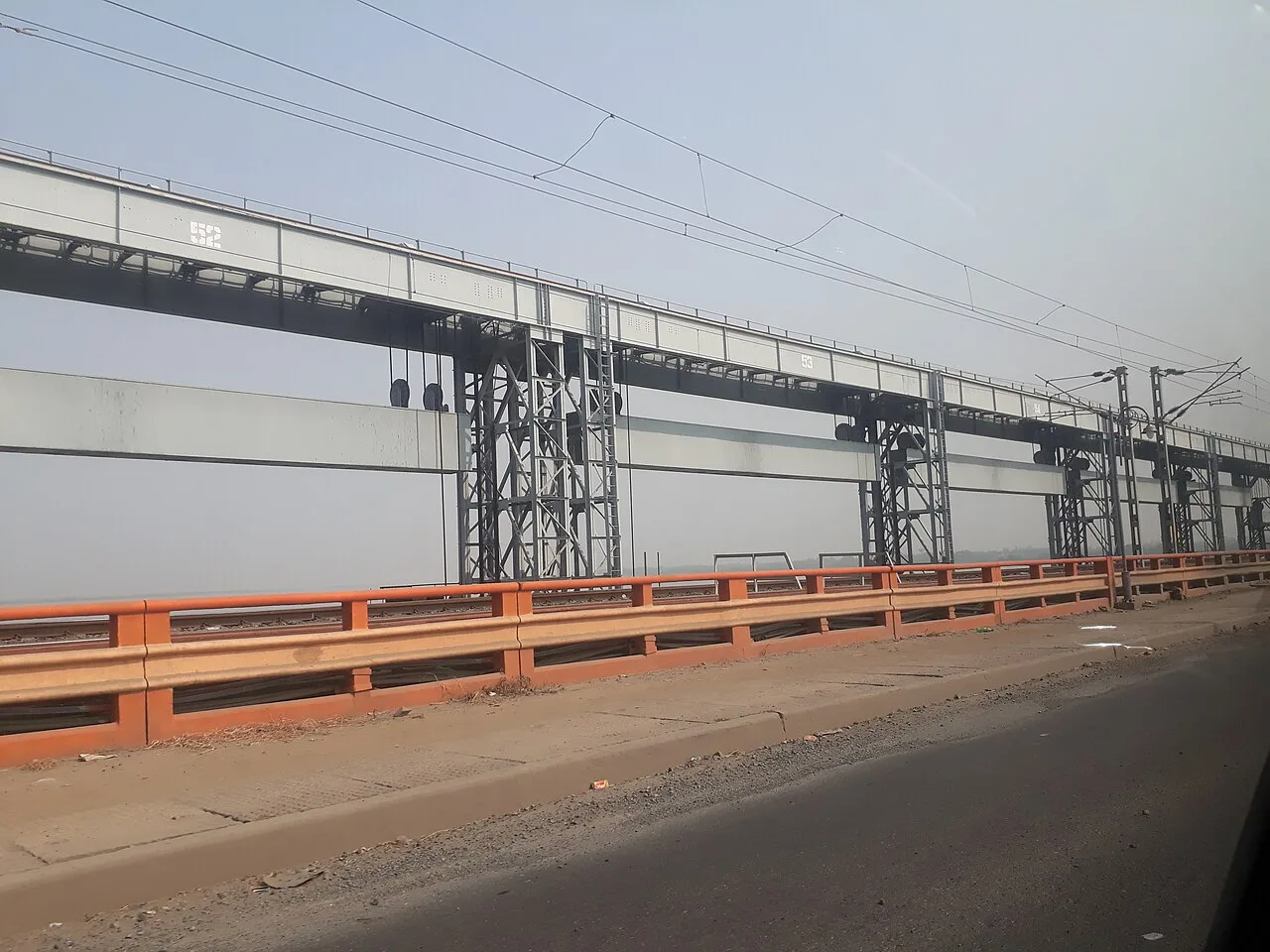
The Ganga/Ganges water-sharing treaty between India and Bangladesh was signed at New Delhi on 12 December 1996. Article XII provides a thirty-year term from signature and renewal through mutual consent. That places the original term's endpoint in December 2026, but the calendar alone does not establish that a renewal, replacement agreement or interruption has occurred.
The useful distinction is between the treaty's written duration and the latest verified diplomatic status. This guide explains that distinction, the river-measurement questions behind sharing claims and a practical method for reading renewal news. It concerns India, Bangladesh and sharing at Farakka, not the separate Indus Waters Treaty involving India and Pakistan.
What exactly does the treaty's thirty-year term establish?
The original text establishes when the treaty entered into force, how long its stated term lasts and the basis for renewal. Article XII connects entry into force with signature and specifies thirty years, renewable through mutual consent. It provides a legal starting point for the duration question, rather than evidence that any later negotiation has already succeeded.
Read the clause in the document submitted to the United Nations by the two governments, not only in a search summary. A primary text lets you distinguish duration from other provisions. Keep the article number with your notes so that a reader can locate the basis for the statement without searching a long collection of commentary.
Treat the date calculation and the status claim as two separate tasks. Adding thirty years to the signing date explains why December 2026 matters. Determining what governs after the original term requires the relevant subsequent evidence. The first task cannot substitute for the second, even when a headline presents both as one inevitable event.
The country and state terminology guide supports the distinction between states and the governments acting for them. A treaty concerns the parties and instrument specified in its text. A change in political leadership or a dramatic speech does not, by itself, establish a new international agreement.
Does renewable by mutual consent mean automatic renewal?
No. A provision allowing renewal through mutual consent identifies a basis for agreement; it does not itself prove that the parties have supplied that consent for a new term. Look for an authoritative subsequent instrument or official confirmation with clear scope. A proposal to renew and a completed renewal should be reported with different verbs.
For a hypothetical comparison, imagine two governments announce that officials will explore options for extending an arrangement. That establishes a planned process. If they later agree on negotiating principles, the process has advanced, but the evidence still needs to show what was finally agreed and when it applies. Do not collapse those stages into a single completed outcome.
The form and legal effect of a later document must be assessed from that document and applicable authority. A joint statement may contain a binding commitment, a political intention or a mixture of subjects, depending on its wording and context. Avoid assuming that its title alone settles the question. Read the operative language and any implementation details.
When current evidence is unavailable, state the established duration and the specific missing status information. That is more useful than repeating broad warnings or predicting that sharing must either stop or continue automatically. The reader should understand exactly which part comes from the original treaty and which part would require a new record.
What does the agreement cover at Farakka?
The treaty concerns sharing Ganga/Ganges waters at Farakka between India and Bangladesh. An Indian government implementation summary describes the lean-season period from January through May and ten-day sharing intervals. That defined location and period matter: a national annual water total or a photograph from another river does not measure performance under this arrangement.
Begin with a labelled basin map. Identify the river, the sharing location and the countries involved. Distinguish a basin, a political boundary and a measurement point. A river crossing a map does not mean every related water question is governed by the same agreement. The treaty's scope must come from the instrument.
The India geography study guide can help establish the broader country context. Keep the map useful but modest: its job is to orient the reader, not prove the volume released on a particular day. Hydrological claims require measurements with a location, date, unit and method.
Do not confuse a barrage, reservoir, river reach and monitoring station. These terms describe different physical or operational features. If an article uses them interchangeably, pause before accepting its conclusion. A clear glossary beside a map can prevent a large amount of confusion without requiring a student to reproduce an engineering assessment.
Why is dry-season flow different from annual water availability?
Annual totals combine conditions across a whole year, while a dry-season question concerns availability within a particular period. Water can be abundant at one time and limited at another. A sharing arrangement tied to a season therefore needs evidence from that season, rather than a claim based only on the annual average.
Imagine a hypothetical river with a large short-lived high-flow period and much lower flow for several months. Two years could have similar annual totals while differing substantially during the months important for a particular use. This example illustrates why timing matters; it is not a measured account of the Ganges in any specific year.
The same distinction applies to averages within a season. A ten-day average can conceal daily variation, while an instantaneous measurement cannot describe the entire ten-day interval. Use the time basis specified by the source and do not silently substitute one for another. If the evidence is incomplete, describe the interval it actually represents.
Separate availability from demand
The amount of water present and the amount needed for a purpose are different measures. Agriculture, drinking-water supply, navigation and ecosystems raise different questions about timing and location. To assess a particular claim, identify both the physical measurement and the stated requirement. A general statement that water is important does not establish whether a specific obligation was met.
How should discharge, volume and water level be compared?
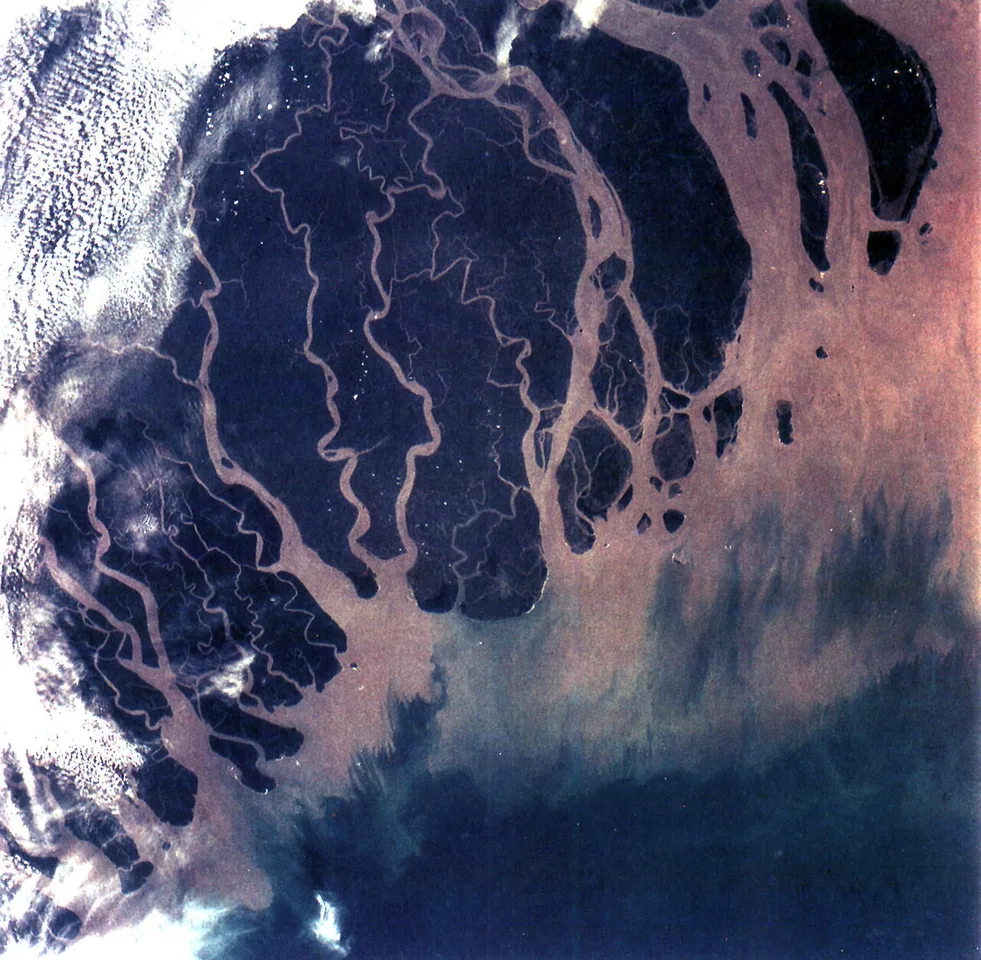
The delta and Sundarbans seen on 6 November 1994. Historical basin context, not a measurement of today's discharge.
Discharge is the volume passing a location per unit time; volume is an amount of water; water level describes height relative to a reference. They are related but not interchangeable. A river photograph may show a visible level, but it cannot establish discharge or treaty compliance without the relevant measurement and interpretive context.
USGS educational material explains discharge through channel cross-sectional area and average velocity. This helps show why depth alone is insufficient: the shape of the channel and the speed of the water also matter. A wider river at a lower visible level is not automatically carrying less water than a narrower channel somewhere else.
Units must be preserved. Cubic metres per second and cubic feet per second are flow rates, while a storage figure uses a volume unit. If a report uses cusecs, establish that it means cubic feet per second in that context. A missing unit can turn a plausible-looking number into something impossible to interpret.
For a hypothetical calculation, a constant discharge of 100 cubic metres per second for 60 seconds represents 6,000 cubic metres passing the location. A real river varies, so a longer-period volume requires the relevant flow record rather than assuming that one instant persists unchanged. Label the constant-flow assumption instead of presenting classroom arithmetic as a field measurement.
How can readers distinguish treaty review from renewal negotiations?
Review examines an existing arrangement under its terms, while renewal concerns continuation through a subsequent agreement. The original treaty contains a review provision separate from Article XII's duration clause. A meeting about implementation, a technical exchange and a renewal negotiation can overlap, but they should not be treated as identical without evidence of the meeting's stated purpose.
A 13 February 2026 Indian parliamentary answer stated that bilateral renewal discussions had not yet commenced at that time. That is a dated official statement, not a description of every later month. It illustrates why the reporting date matters: an accurate historical answer can become misleading if repeated as an undated current status.
When reading a later announcement, identify the participants, mandate and outcome. Were officials gathering data, discussing national requirements, considering draft terms or announcing a completed instrument? Preserve the source's distinctions. An internal consultation and a bilateral meeting are different events even if both relate to the same eventual decision.
The public-record news guide offers a parallel method for distinguishing a proposal, statement and institutional action. Apply that method here while respecting the international context. Domestic political support can matter to negotiations, but it does not alone establish what both treaty parties have agreed.
| Record | What it can establish | What it cannot establish alone |
|---|---|---|
| Original treaty text | Written obligations and duration | Every later diplomatic development |
| Dated parliamentary answer | The government's stated position then | An unchanged position months later |
| Technical meeting notice | A meeting and its announced scope | A completed renewal |
| Flow measurement | A value at a defined place and time | Full compliance without relevant terms |
| Subsequent agreed instrument | Its own terms and effective arrangements | Facts outside its stated scope |
What evidence is needed before alleging a water-sharing breach?
Identify the obligation, measurement period and reliable data before reaching a compliance conclusion. A low river level, difficult farming conditions or a political allegation may be relevant context, but none alone proves breach of a specified treaty provision. The analysis must connect the applicable rule with the evidence for the same place and period.
Start by writing the alleged failure precisely. Which party was required to do what, under which clause and during which interval? Then locate the relevant measurement and any official account of implementation. If the claim concerns a special condition, read that condition in full rather than applying a simplified general rule.
Consider alternative explanations without inventing them as facts. A change in rainfall, upstream or downstream use, channel conditions and measurement timing can all be questions to investigate in a hydrological study. Their possibility does not excuse a breach or prove one. It explains why a complete assessment needs more than a dramatic image.
The dams, storage and floods guide helps distinguish infrastructure functions, though it concerns a different national setting. Do not import its examples as evidence about Farakka. Comparative learning is useful when it clarifies terminology; it becomes misleading when it substitutes another river's data for the one under discussion.
How can students build a useful treaty-renewal research file?
Build a file with the original text, a short timeline, a labelled map and a table of later verified announcements. Separate legal duration, diplomatic status and hydrological evidence into distinct sections. The final explanation should answer what is established, what changed and which conclusion still requires additional records.
In the timeline, include the signing date and the original duration clause, then add later records with their exact dates. Label an announcement of future talks as an announcement, not as completed talks. If a newer record supersedes an older statement, keep both and explain the change rather than erasing the chronology.
Make the evidence easy to audit
For every water figure, record location, unit, interval and source. For every diplomatic claim, record speaker or issuing institution, publication date and the action described. Keep the wording of the conclusion close enough to the evidence that a classmate can check it without accepting your judgement on trust.
Write a short final paragraph that distinguishes the treaty's original December 2026 endpoint from whatever subsequent status you have actually verified. Do not predict a breakdown or completed renewal to create a dramatic ending. A careful explanation can remain useful while the diplomacy changes because it tells readers how to identify the next meaningful piece of evidence.
Keep calculations on a separate worksheet and name every assumption. If you convert units, preserve the original value beside the result. If the source describes an average, retain that label. These small habits prevent a later summary from turning an educational calculation into an apparently observed release figure, which is especially important when water claims are politically disputed.
Ask what a new document would need to show
Before checking renewal news, write the information that would change your conclusion: the parties' agreement, its scope, the relevant period and any effective-date arrangement. This keeps the search focused on meaningful evidence rather than the largest headline. A new meeting may be important without answering all those questions, and a technical report may clarify measurements without changing the legal term.
Use a separate line for each unresolved issue. For example, legal continuation, allocation details and monitoring procedures are related but distinct subjects. Evidence answering one should not silently fill the others. If an official communication addresses only future discussions, preserve that limited result and wait for the instrument that establishes the next stage.
This approach also improves classroom debate. Students can disagree about policy preferences while agreeing on what the original clause says and what later evidence is available. The shared factual foundation makes it possible to discuss fairness, seasonal demand and cooperation without inventing a completed diplomatic outcome.
Sources
Source 1 · Source 2 · Source 3 · Source 4
Image credits: Cover: Pinakpani, source, CC BY-SA 4.0. Resized and converted to WebP. Article image: NASA, source, Public domain. Resized and converted to WebP.
Found an error or an outdated detail? Report a correction with the article URL and original source.