
Karan Johar: Director, Producer and Storytelling Roles
Understand Karan Johar’s directing and producing roles, distinguish film credits from promotion, and practise a short evidence-based scene analysis.

Karan Johar is a filmmaker whose directing, producing and public-facing roles need to be distinguished when studying a particular screen work. A familiar name on a poster does not identify every creative responsibility. Begin with the film credits, then examine how the completed work tells its story through image, performance, sound and editing.
A concrete example helps. The distributor's page for Kuch Kuch Hota Hai credits Karan Johar as director and Yash Johar as producer. That historical credit pair shows why “a Karan Johar film” and “produced by Karan Johar” are not automatically interchangeable descriptions.
This guide takes a film-study angle rather than a celebrity-news angle. It explains how to read roles, build a scene analysis and evaluate claims about popularity or new projects. The aim is to make an interpretation that another viewer can test against the work and its documented credits.
What is the practical difference between directing and producing?
Directing concerns the interpretation and realisation of a screen work with its performers and creative departments. Producing concerns developing, organising and supporting the project through its production and delivery arrangements. Responsibilities vary, so the exact credited role is more reliable than an assumption based on a person's public prominence.
A director works with cast and crew on the film's dramatic and audiovisual choices. Those choices are collaborative. Cinematography, production design, editing and sound design have their own specialist contributors whose work should remain visible in a serious analysis.
A producer can help bring a project into existence without directing the actors or staging every scene. Equally, the same individual can hold several roles. The correct description follows the particular project rather than a fixed label attached to the person.
An executive producer or presentation credit needs its own wording. A credit establishes that someone is credited in that capacity; it does not independently describe every private decision or financial arrangement behind the production. Avoid reconstructing a contract from its shortest public label.
For an assignment, create a role card with title, credited person and the source used. Start with director, producer, screenplay and principal cast, then add departments relevant to your chosen scene. This supports accurate attribution without requiring an exhaustive list of every contributor.
When discussing Johar, make the sentence project-specific. “Johar directed this film” is a checkable claim if the credits establish it. “Johar made every creative choice” is a much broader claim that the credits alone cannot support.
How should Dharma and Dharmatic company descriptions be used?
Company pages are primary evidence for how an organisation presents its activities and identifies its team. Dharma Productions describes film production and related work, while Dharmatic Entertainment describes a focus on digital fiction and non-fiction formats. Use those descriptions as attributed organisational statements rather than independent verdicts on artistic or commercial success.
A company's catalogue can help identify a title and locate further credit information. It should not cause you to assume that every associated work has the same director, genre or production structure. Check the title-level record.
A promotional phrase such as “leading” expresses positioning. It does not supply a defined ranking or measurement. If a comparison matters, identify the metric, period and competing group before presenting it as an established industry fact.
Similarly, an official team page can identify a published role on the date consulted. It does not explain every ownership interest, contractual authority or financial value. Those are separate research questions with different evidence requirements.
For a student project, separate “company description” from “analysis of a work.” The first establishes an institutional context; the second requires attention to the film. An impressive corporate summary cannot substitute for an explanation of framing or a character's decision.
This also protects the profile from becoming promotional copy. Name the organisation where necessary to establish context, then return to what the evidence helps the reader understand. The educational value lies in distinguishing responsibility and interpretation, not repeating every favourable adjective from a company page.
How can you analyse a scene without retelling its plot?
Identify what changes during the scene and explain how film language communicates that change. Use a short plot outline only to establish context. Then examine framing, performance, sound and editing as evidence of how the audience is guided towards a particular understanding or emotional response.
Start with two questions: what does each character want, and what prevents that goal? Conflict can be spoken or silent. A scene may change a relationship through a hesitation or withheld answer rather than a dramatic declaration.
Choose a manageable excerpt from a legitimately available copy. Watch it once normally, then again while recording shot changes and important sounds. A shot list helps turn an initial impression into a sequence you can inspect.
Suppose an invented scene begins with two people sharing a wide shot and ends with separate close-ups. That change could suggest growing separation, but the interpretation needs dialogue, performance and context. The camera arrangement alone does not prove a single meaning.
Describe one action precisely before interpreting it. “The reply is delayed while the camera remains on the listener” gives evidence. “The scene is emotional” gives a reaction without explaining the method.
Finish the paragraph by connecting technique to the scene's change. Perhaps the delayed reply makes uncertainty visible or a reaction shot shifts attention from an accusation to its effect. This is analysis because it explains how the telling contributes to the meaning, rather than merely listing what happened.
What should you notice about framing, setting and performance?
Observe where people and objects appear, how they move and what the shot allows the viewer to see. Framing, lighting, costume, props and blocking contribute to the scene's presentation. Their significance comes from relationships within the work, not from a rule that one colour or camera angle always means one thing.
Mise-en-scene is a useful term for the arrangement of elements presented within the scene. Use it to organise observations, then name the actual detail. A doorway separating characters or an object handled repeatedly is more informative than a technical term left unexplained.
Blocking concerns performers' positions and movement. In an invented family argument, a character moving away from a shared table can change the social arrangement before any dialogue explains it. Ask how the movement interacts with the setting and others' reactions.
A close-up can make small performance choices more visible. Eye direction, a pause and a restrained gesture may carry information. A wide shot can preserve relationships between bodies and surroundings. Neither is inherently more truthful or more emotional.
Camera movement can reveal information or change the viewer's proximity. Describe where it begins, what it reveals and why that timing matters. Avoid assuming a smooth movement is merely decorative or that a static frame contains no active choices.
For screen performance, distinguish the character's behaviour from the actor's personal identity. A convincing expression is evidence of a performed moment. It does not establish the performer's private views or the director's biography. This distinction keeps character analysis grounded in the work.
How do music, dialogue and editing guide interpretation?
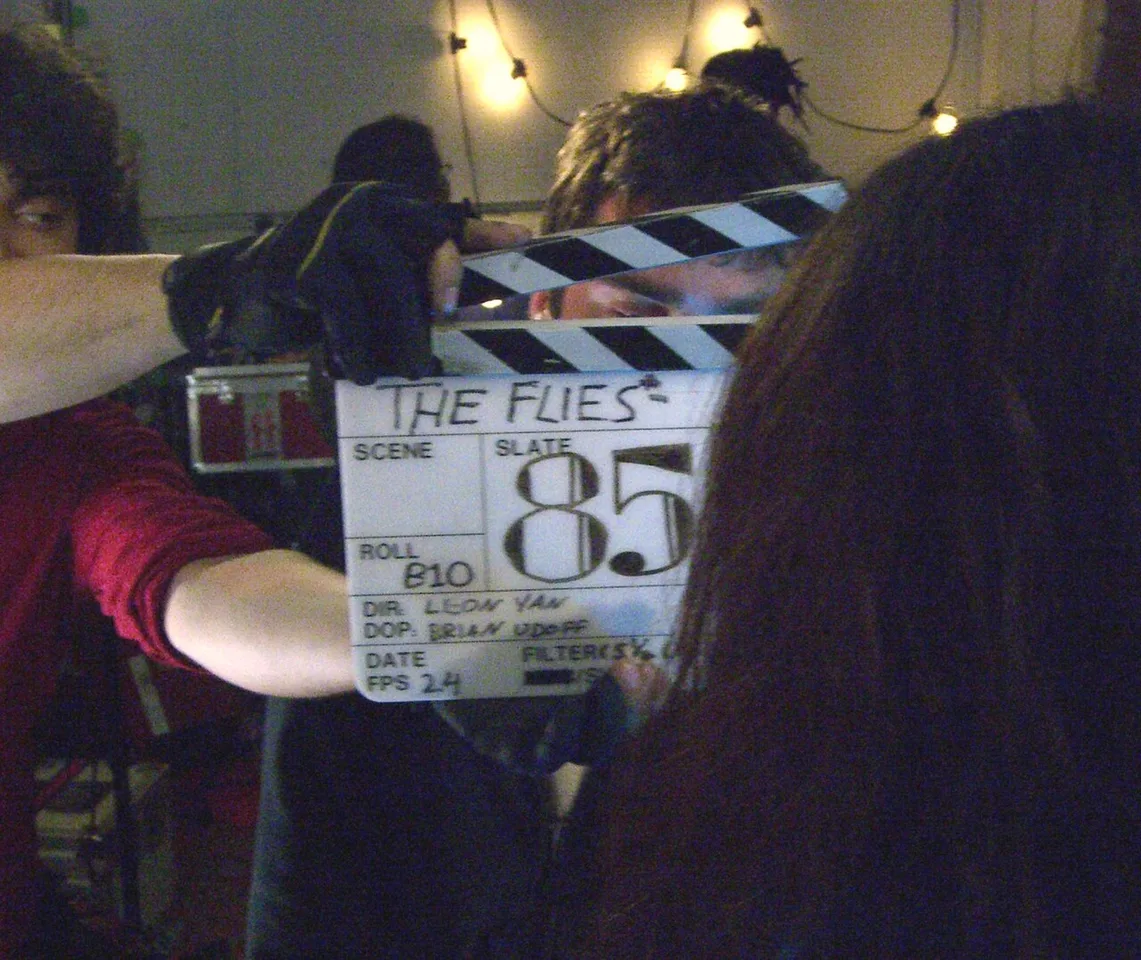
A clapperboard on the London set of the short film The Flies in 2007 illustrates production workflow; this is not a Johar production.
Sound and editing influence what the viewer notices, how time is experienced and which relationships seem important. Listen for dialogue, silence, environmental sound and music, then inspect when cuts occur. The meaning arises from their combination with the image rather than a soundtrack being added as an unrelated emotional instruction.
An invented scene can demonstrate the principle. If footsteps continue over a cut before the walker is shown, the sound may connect spaces or prepare an entrance. If music stops before a reply, the silence may give that reply additional weight.
Subtext is what a statement or action implies beyond its literal surface. A polite line can coexist with hostile body language. Explain the contrast rather than quoting the line as if words alone settled the relationship.
Continuity can help the audience follow space and action, while an abrupt change can disrupt expectation. Identify the observable edit and its effect before calling it a mistake. An unusual transition may be intentional, but intention should not be invented as a private fact.
Music can relate to memory, atmosphere or the scene's dramatic structure. Compare what the scene communicates with and without the musical cue as a thought experiment. Do not redistribute an altered clip unless the necessary rights and permissions are established.
The University of York's film-reading guidance emphasises analysing how a story is told rather than only describing events. Apply that principle by linking one sound choice and one edit to a change in audience understanding. This produces a stronger paragraph than a checklist of terminology.
How can you distinguish criticism, audience response and commercial results?
Treat these as different kinds of evidence. Critical response consists of particular evaluations, audience response concerns the views or behaviour of defined groups, and commercial results concern measured financial activity. Popular discussion does not establish unanimous approval, and a revenue figure does not independently establish profit.
A box-office total needs territory, period, currency and reporting basis. Domestic and worldwide figures cannot be interchanged, and gross receipts differ from amounts retained after distribution and other arrangements. If the source does not define the number, avoid using it to declare profitability.
A review score also needs context. How many reviews contributed, what scale was used and which publication or platform collected them? A number summarising one sample should not be described as the opinion of every viewer.
For criticism, quote or paraphrase a particular argument and inspect its supporting examples. A negative judgement can be thoughtful; a positive judgement can be weakly supported. The educational question is how the interpretation connects evidence with evaluation.
Use this comparison:
| Claim | Evidence needed | Frequent mistake |
|---|---|---|
| Johar directed a title | Title-level credits | Inferring direction from company association |
| A scene emphasises distance | Image and sequence analysis | Treating a personal reaction as proof |
| Critics praised the film | Defined reviews or a specified sample | Generalising from one comment |
| A film earned a stated gross | Dated financial reporting | Calling revenue profit |
| A new project is confirmed | Current responsible announcement | Treating discussion as a release commitment |
A balanced film study can focus on technique without settling financial performance. Choose evidence that serves the question and leave unrelated numbers out.
How should trailers and upcoming-project claims be interpreted?
A trailer is a selected promotional construction, while a completed film is a longer work with its own sequence and context. A development report, casting discussion and confirmed release date are also different stages. Identify the status of the claim before treating it as established production information.
A trailer can rearrange moments, emphasise one tone and omit another. It is legitimate evidence for how a work is being presented, but not a complete basis for explaining every character arc or the final editing structure.
For an upcoming title, record exactly what the responsible source announced. A statement that development has begun does not establish that filming is complete. A casting rumour does not become confirmation because several accounts repeat the same original claim.
Avoid attaching a future project to Johar as director unless the credit is explicitly established. A producing connection, interview mention or appearance in a promotional video can indicate involvement without identifying that particular role.
The same care applies to a release date. Announced plans can change, so retain the source date and check the current communication before writing practical viewing information. Do not convert a forecast into a past event.
For an assignment, make a status timeline with confirmed announcement, observed material and unresolved question as separate categories. This gives a reader a clear account of what is known while keeping speculation from filling gaps in the record.
What does a strong short film-study assignment look like?
Choose one work, verify relevant credits and build a focused argument around a short scene. Describe the narrative change, analyse two or three formal choices and consider an alternative interpretation. End by explaining what the evidence establishes about the scene rather than summarising a celebrity's reputation.
A workable structure begins with a brief claim: the scene makes a changing relationship visible through spatial separation and delayed response. The next paragraphs supply precise moments and explain their effects. The final paragraph tests whether another reading fits the same evidence.
Use time references in your private notes so you can revisit the selected moments. The published paragraph need not contain a timestamp for every observation, but your research should allow you to locate the evidence again.
Keep fiction and evidence distinct. A character's argument may be central to the story without representing the filmmaker's personal position. If you want to connect an interpretation with a documented interview, attribute the interview and explain how it relates to the work.
Credit collaboration. A director-focused study can acknowledge editing, sound and performance without losing its focus. This makes the account more accurate and helps readers understand how screen storytelling is produced through several connected crafts.
Karan Johar provides a useful subject because public identity, company association and film-level responsibilities can easily become blurred. A careful assignment restores those distinctions and then does the more interesting work: explaining how a particular scene creates meaning through choices the viewer can actually observe.
Sources
Source 1 Source 2 Source 3 Source 4 Source 5
Image credits: Cover: Laura Lee Dooley, source, CC BY 2.0. Resized and converted to WebP. Article image: Girolamo Savonarola, source, CC BY 2.5. Resized and converted to WebP.
Found an error or an outdated detail? Report a correction with the article URL and original source.